
You're standing at the harbor with two very different problems. One person in your group has never breathed underwater and wants to try Kona Scuba Diving without committing to a course. The other is certified, current, and bored by shallow reef dives. Booking you both onto the same trip usually disappoints one of you. Match the dive to the diver, then match it to the day's conditions, and Kona works beautifully.
Choose the Right Kona Dive for Your Skill Level
Start with certification, not scenery. Lava tubes and mantas don't care how keen you are if your buoyancy, air management, or night experience aren't ready.
| Tour | Best For | Main Highlights |
|---|---|---|
| Discover Scuba Diver (DSD) | Not certified, first dive | Instructor-led basics, then shallow reef dive |
| Morning Introductory Scuba Dive | First-time divers on a boat | Introductory reef dive in calm conditions |
| 2-Tank Local Morning Dive | Certified divers | Coral gardens, ancient lava tubes, dramatic arches |
| Manta Ray Night Dive | Snorkelers and certified divers | Manta rays feeding under lights at night |
| 2-Tank Manta Dive and Snorkel | Snorkelers and certified divers | Manta viewing plus a second reef dive or snorkel |
| Black Water Night Dive | Confident divers comfortable at night | Deep-water animals drawn to lights in open water |
| Premium Advanced 2 Tank Trip | Certified advanced divers | Deeper, remote sites and drift dives |
A Three Step Decision
1. No certification, start with a DSD. An instructor teaches breathing, mask clearing, and equalizing in a calm setting before a shallow reef dive. Don't jump straight to a crowded night dive for your first bubbles.
2. Newer certified divers, book the morning 2-tank trip. Daylight, a visible bottom, and a guide setting the route let you settle your trim and air use. You'll still see coral gardens, ancient lava tubes, and dramatic arches without adding darkness or current.
3. Experienced divers, add advanced and night dives. That's where deeper sites, drift, and open-water blackwater make sense, because you can hold position, manage a light, and look after a buddy at the same time.
Kona water is warm and conditions are often calm, but winter swells make shore entries harder. Check conditions before you lock in a plan, and compare departures on the Kona diving tours page. Pick the one tour that matches your logbook today, not the diver you hope to be next year.
Certification and Refresher Options Before You Dive
Your starting point decides the course. Don't buy full certification if you only want one guided dive, and don't rely on an old card if your skills have faded.
| Starting Point | Course or Program | Result |
|---|---|---|
| Never dived | Discover Scuba Diver (DSD) | One guided shallow dive, no certification |
| Never dived, wants certification | PADI Scuba Certification Course | Open Water certification |
| Trained elsewhere, partly done | PADI Open Water Referral Course | Finish open water training in Kona |
| Certified, out of water a while | PADI Reactivate | Refresher review and supervised dive |
| Certified, wants depth and skill | PADI Advanced Open Water | Advanced certification |
| Certified, using nitrox | PADI Enriched Air Diver | Enriched air certification for longer bottom times |
| Certified, wants safety skills | PADI Rescue Diver Course | Rescue skills for leading safer dives |
A Discover Scuba Diver session is a test run. You'll learn enough to dive safely under direct supervision, then decide whether you like equalizing, the sensation of breathing through a regulator, and being underwater at all.
If you know you want the card, complete the full certification or bring your referral paperwork and finish your open-water dives here. Details are on the Big Island scuba certification page.
Practical rule: If you haven't dived in more than a year, book a refresher before a manta or advanced trip.
PADI Reactivate covers the skills that rust first, including buoyancy, mask clearing, regulator recovery, and controlled ascents, followed by a supervised dive. It's cheaper than ruining a premium night trip because you're fighting your gear. Advanced Open Water then builds navigation and deeper diving, Enriched Air teaches nitrox planning, and Rescue teaches you to spot and manage problems before they become emergencies.
Kona Dive Seasons and Conditions
When should you book? Kona is diveable through the year because the water stays warm and many days are calm. Season matters most at the shoreline. Winter swells can turn a lava-rock entry that looked easy in a photo into a surge-filled scramble, while a boat can often choose a more sheltered site.
A Planning Sequence That Works
- Choose a flexible date window for shore dives. One fixed morning gives swell no room to drop.
- Book boat trips with a backup day. If swell builds, you'll reschedule instead of losing the experience entirely.
- Check surf and swell the day before. Direction matters as much as size, because a site exposed to that swell can be rough while another stays workable.
- Ask how cancellation decisions are made. You want an operator who'll call off a trip when entries, exits, or boat ladders become unsafe.
Night manta and blackwater trips add another variable. You're not just waiting on weather, you're waiting on animals, plankton, and water movement. A flexible date improves your odds, but it doesn't create a guarantee.
Don't judge a shore site from the parking lot. Watch several wave sets, look for whitewater over the exit, and note whether surge pushes across the entry. If you're already making excuses for the conditions, that's your answer. Pick the boat, pick another site, or pick another day.
Top Kona Dive Sites and What You Will See
Good site selection is mostly access plus conditions. A superb reef is a bad choice if the entry is exposed today or the dive demands skills your group doesn't have.
| Site | Access | What You Will See | Best For |
|---|---|---|---|
| Garden Eel Cove (Makako Bay) | Boat or night snorkel tour | Manta feeding under lights, garden eels | Night manta viewing |
| Keauhou Bay (Manta Village) | Boat or night tour | Mantas circling lights above the reef | Night manta viewing |
| Old Kona Airport MLCD | Shore entry or state mooring | Coral and reef fish, sheltered northwest cove | Independent shore divers in calm water |
| Kealakekua Bay | Boat | Clear water and reef fish in a managed marine area | Relaxed reef dives |
| Pawai Arches | Boat | Arches, lava formations and abundant marine life | Snorkelers and reef divers |
Garden Eel Cove gives divers a defined viewing area, garden eels in the sand by day, and mantas feeding under lights after dark. Its protected setting and reef structure make positioning easier than at a more exposed site.
Keauhou Bay, called Manta Village, is the other major night site. Divers watch from below while mantas circle lights above the reef. It can be excellent, but crowding and the layout make guide positioning especially important.
Shore and Daytime Reef Choices
The Old Kona Airport Marine Life Conservation District suits independent certified divers who can judge surf themselves. Use the partially protected northwestern cove when possible, and treat the southeastern entry as a calm to moderate water option only.
Kealakekua Bay is better reached by boat, with clear water, reef fish, and a relaxed pace inside a managed marine area. Pawai Arches is a boat site where lava formations and arches give snorkelers and divers plenty to explore without needing depth.
Don't build a high-density manta plan around Kaukalaelae Point, because the bottom habitat isn't suitable for that kind of concentrated scuba viewing. I would choose boat sites for variety and easy entries, and shore sites only when your group can independently handle rock, surge, navigation, and the exit.
Manta Night Dives and Why Garden Eel Cove Wins
At dusk the lights switch on, plankton gathers in the beams, and a manta may roll through with mouth open. Hawaii's Department of Land and Natural Resources describes mantas as plankton feeders that may reach wingspans of roughly 22 feet or more, with mantas observed on approximately 80% of dives at Garden Eel Cove. That's a strong record, not a promise.
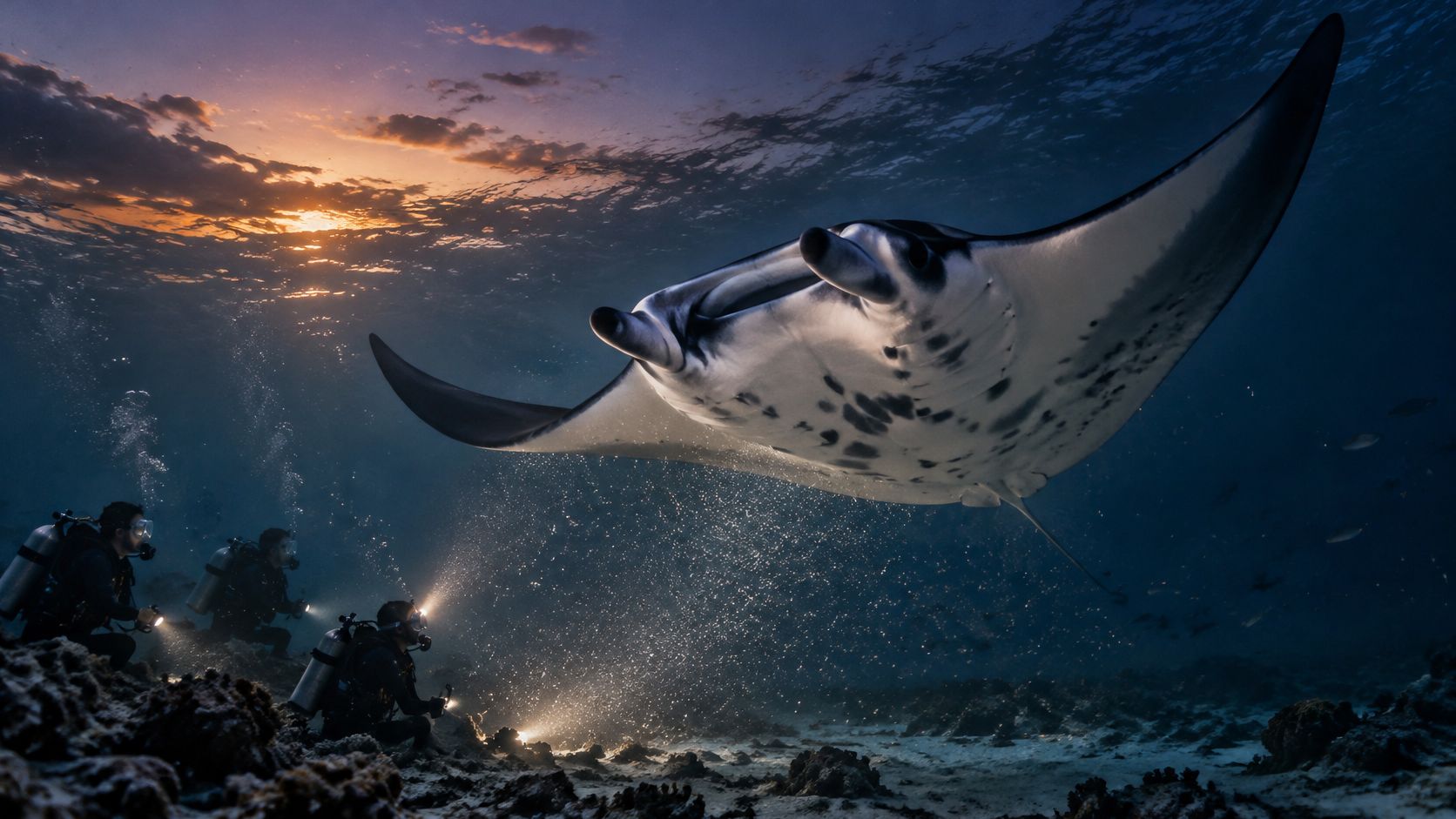
Garden Eel Cove is the superior choice for the manta dive tour because of its protected location, better viewing area, and better reefs. You can settle into position, watch the reef before dark, and stay oriented while animals feed overhead. Keauhou can produce great nights, but Garden Eel Cove gives a cleaner setup for divers and snorkelers sharing the water.
The biology explains the method. Mantas concentrate at Makako Bay and the Keauhou coastline to filter-feed on plankton, and fixed lights make that food easier to find. Chasing an animal breaks up the feeding pattern and puts you in its path. Staying still works better.
How to Dive It Well
- Stay neutrally buoyant: Hold position without kneeling on coral or stirring sand into the lights.
- Let mantas approach: Don't touch, pursue, or block an approach path.
- Keep gear tucked close: Clip consoles and lights close so nothing dangles into a close pass.
- Watch above and below: A ray can turn under the group while another passes overhead.
The identified Kona population in the period studied was probably fewer than 200 animals, and individuals are recognizable. That small population is exactly why careful behavior matters.
Snorkelers can join from the surface while certified divers watch from below, which makes mixed groups easy. Compare the 2-Tank Manta Dive and Snorkel tour, read more about the night manta ray dive in Kona, and choose Kona Honu Divers if you want that Garden Eel Cove setup.
Arrive early, bring a dive light, keep hands and fins close, and treat every sighting as a bonus. Some nights deliver repeated barrel rolls. Some nights the plankton is thin and the mantas feed elsewhere.
Blackwater, Lava Tube and Advanced Dive Options
You've done the morning reef, your buoyancy is solid, and you want something stranger. Before booking, answer three checks.
- Is your certification matched to the depth? Advanced sites and drift dives punish poor air planning.
- Have you dived at night before? Blackwater removes the reef, the bottom, and most visual references.
- Are you comfortable drifting in current? You need to stay with your buddy, hold a safety stop, and deploy your skills without a line to grab.
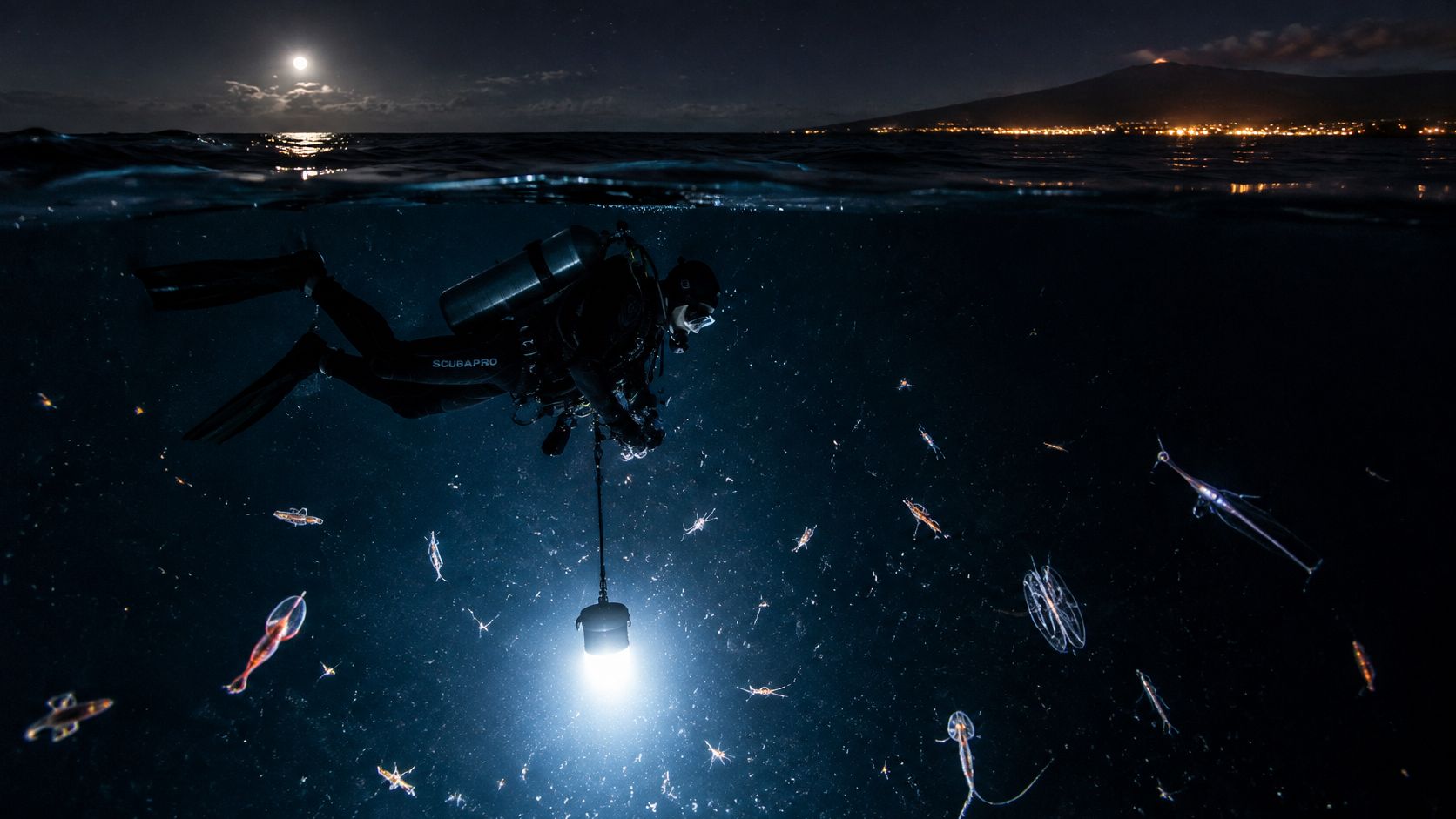
The Black Water Night Dive puts you in open water after dark, drifting over deep water while lights draw in animals that live far below during the day. It's disorienting in the best way if you're calm, and miserable if darkness already makes you anxious. Review the Kona black water dive and the Black Water Night Dive tour before deciding.
The Premium Advanced 2 Tank Trip is a better fit if you prefer geology and depth to open-ocean drift. Certified divers visit remote, pristine sites, deeper reefs, and drift routes around lava tubes and arches. Check the Premium Advanced 2 Tank Trip for that style of diving with Kona Honu Divers.
If any readiness check is uncertain, start with a morning 2-tank trip and let the guide assess you in daylight.
That's not a downgrade. A good daylight performance tells you far more about your readiness than an old certification card does.
Gear, Rentals and Photography Tips for Kona Divers
Rent the heavy, serviced gear. Bring the gear that has to fit your face and feet.
| Item | Rent or Bring | Why |
|---|---|---|
| Regulator | Rent | Serviced before each trip |
| Buoyancy device | Rent | Serviced before each trip |
| Tanks | Rent | Usually supplied by the operator |
| Mask | Bring | Must fit well |
| Wetsuit or rash guard | Bring | Comfort and fit |
| Personal fins | Bring | Fit and comfort |
| Dive light and backup | Bring | Essential for night manta and blackwater trips |
Rental regulators and buoyancy devices make sense because they're serviced before trips, and you avoid airline weight and post-trip rinsing. Check current scuba rentals before packing bulky kit. A leaking rental mask, though, can spoil every dive, so bring your own if you have one that seals.
Night diving needs a primary light and a backup, both charged or with fresh batteries. Test them on land, agree light signals with your buddy, and clip the backup where you can reach it without looking.
Photographers need extra discipline. The state environmental assessment for Makako Bay and Kaukalaelae Point notes that large camera rigs can alter trim and increase accidental bottom contact or entanglement risk. A compact setup you can control beats a housed system you're wrestling.
- Practice buoyancy before you shoot: Hover first, frame second.
- Streamline fins and rigs near mantas: Nothing should swing into coral or an animal's path.
- Use a fixed position: Let the animal come to you instead of finning after the shot.
Write your gear list before arriving, including chargers, defog, exposure protection, and any prescription mask. Finding a missing cable at the harbor helps no one.
Boat, Shore and Conservation Rules to Follow
Protected status changes how you access a site, but it doesn't calm the ocean. The Hawaii Division of Aquatic Resources states that the Old Kona Airport Marine Life Conservation District extends 500 yards offshore between the west end of the park and the Kailua Lighthouse. Anchoring is prohibited, motorized watercraft can't operate in the designated No Boating Zone except for emergency or enforcement purposes, and commercial operations run only at the state mooring or from shore with the required permit.
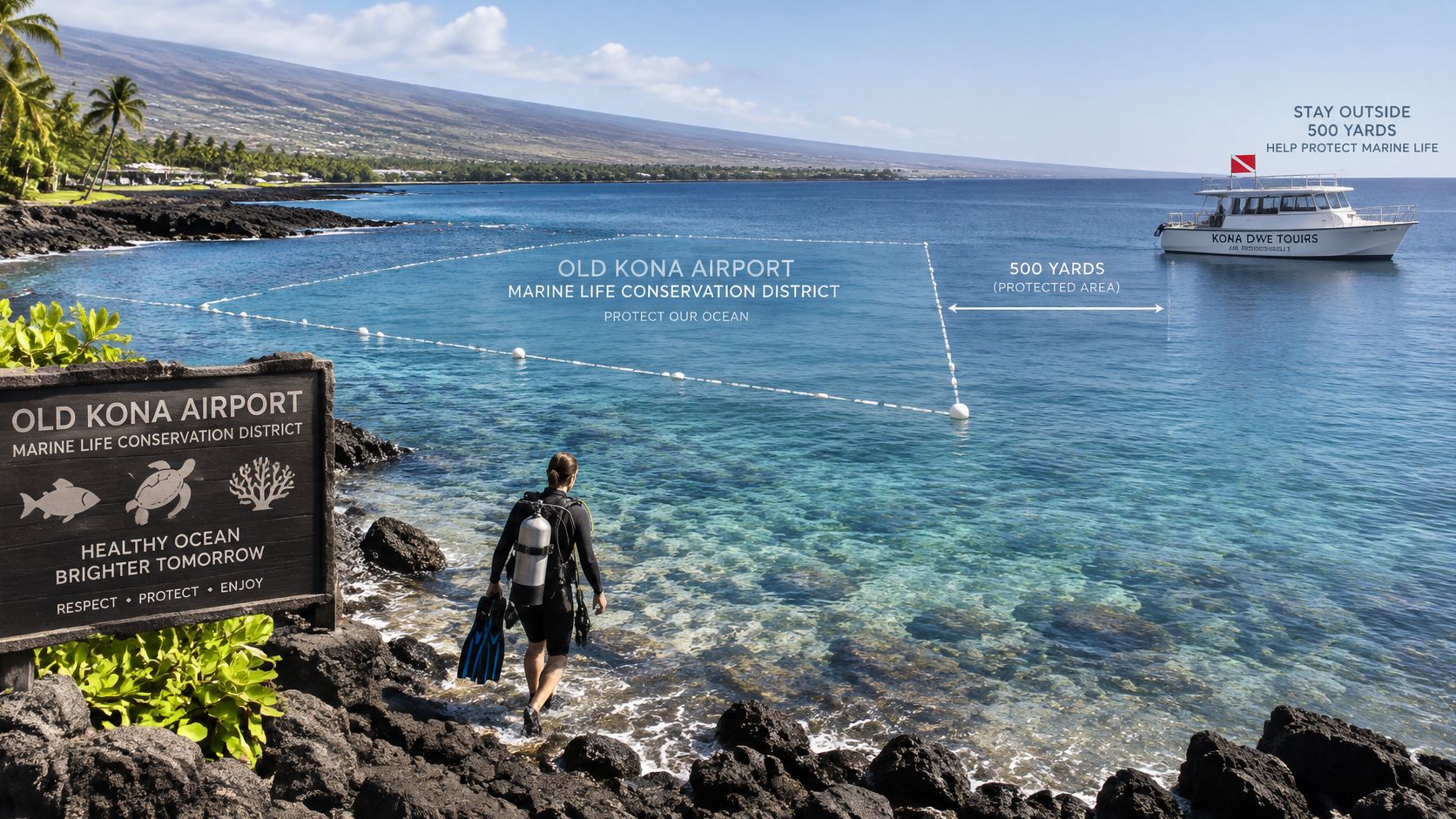
Shore entries here involve sharp coral and lava rock, swells and currents can become dangerous during storms, and there are no lifeguards currently on duty. Use this go or no-go checklist:
- Check swell direction and size before leaving.
- Enter only at a sheltered entry in calm to moderate water.
- Plan the exit before you enter, including an alternate if surf builds.
- Dive with a buddy and keep checking surge, current, and your return bearing.
- Abandon the dive if surf builds. Gear can be rinsed and reused tomorrow.
Crowding is the other management problem. A Hawaii Department of Land and Natural Resources report describes a 2015 assessment that identified at least 42 commercial operators visiting Makako Bay and Keauhou Bay, with 16 to 19 vessels per night and approximately 160 to 190 people in the water simultaneously. That's why separation matters.
The Environmental Standard
- Use designated moorings or approved vessel procedures.
- Stay positively buoyant above the bottom and avoid coral contact.
- Keep clear separation between divers, boats, and manta travel lanes.
Kaukalaelae Point lacks suitable bottom habitat for high-density scuba manta viewing, so don't use it for that type of tour. Hawaii Ocean Watch reported that in 2024, approximately 25% of regularly observed Kona manta rays showed signs of human-caused injury. Hawaii's Division of Boating and Ocean Recreation identifies pelagic manta rays as an Endangered Species Act-listed species and provides sighting reports through its marine species guidance at 1-888-256-9840, option 5. Read the responsible and considerate diver etiquette guide, then plan the site around the rules and that day's water.
Book Your Kona Dive and Confirm the Details
Choose the tour that matches your level and book it now, because night dives fill fastest. Kona Honu Divers focuses on small groups and personal attention from the moment you step aboard, with boats that provide shade, showers, and storage, plus certified instructors for beginners.
The lineup covers the Manta Ray Night Dive, 2 Tank Local Morning Dive, Premium Advanced 2 Tank Trip, Black Water Night Dive, and Morning Introductory Scuba Dive. If you're not certified, the Discover Scuba Diver program teaches the basics in a calm setting before a shallow reef dive. Ask about early diver discounts and dive packages when booking, and confirm current offers, including free nitrox with packages, before you pay.
Three Booking Checks
- Book early for night dives. Manta and blackwater spaces are the first to go.
- Confirm certification or refresher status before the trip. Bring your card or digital proof.
- Ask about conditions the day before. Confirm meeting place, swell expectations, and any rescheduling plan.
Don't book an advanced trip to prove something, and don't book an introductory trip if you're already an experienced, current diver. The right match gives the guide room to show you Kona properly instead of spending the dive managing preventable problems. Book the trip that fits your skills, your group, and the forecast.
Kona Honu Divers offers beginner through advanced Kona diving, including morning reef trips, Garden Eel Cove manta nights, blackwater dives, certification, refreshers, and rentals. If you're ready to match your experience to the right boat, site, and conditions, visit Kona Honu Divers and book the dive that fits you.