
Ask how many manta rays live off Kona and many change the subject. The questions that fill a booking email are about depth, water temperature and whether the boat has a head, and those are fair things to want to know. But the size of the local population is the fact that shapes your entire night in the water, because this is a small, resident group of reef manta rays rather than a highway for animals passing through.
Everything about a Kona manta ray dive follows from that. The rays return to the same stretch of coast after dark because the food is dependable there. The plankton gathers because the lights are on. Your stillness, the site's shelter and the operator's discipline decide whether the evening is calm or a scramble.
What the night really is: a wild animal arriving at a predictable food source and tolerating a circle of silent observers. Everything you do should make that tolerance easier.
Get the format right, then the site, then the operator, and the rest of the evening tends to look after itself.
Kona Manta Ray Dive at a Glance
A Kona manta ray dive is a guided night dive in which you kneel on bare sand inside a lit viewing area while reef manta rays (Mobula alfredi) feed on plankton gathered in the water above the dive lights. You don't swim around, you don't search, and you don't feed anything. The lights set the table and the rays arrive when they're hungry.
The same feeding event has a second viewing platform. A night snorkel floats you on the surface holding a light board, looking down as the rays rise through the beam. Same site, same animals, same natural behavior. What changes is where your body sits and what you can see of it.
Format comes first, because it decides your certification, your gear and the kind of evening you'll have.
Night dive vs night snorkel at a glance
| Feature | Manta Ray Night Dive | Manta Ray Night Snorkel |
|---|---|---|
| Where you are during the encounter | Kneeling on the sandy seafloor in a designated viewing area | Floating on the surface above the lights |
| Who can join | Certified divers; the entry level is an Open Water rating, confirmed with the operator at booking | Divers and snorkelers; minimum age and swimming requirements are set by the operator and confirmed at booking |
| Gear | Scuba kit, cylinder, weights and a dive light | Mask, snorkel, fins, exposure suit and a flotation option such as a light board or noodle |
| Positioning | Stationary, kneeling on sand below the feeding lane | Stationary at the surface, holding the light board |
| Briefing | Crew briefing on manta biology and the rules of passive observation | Shorter safety briefing covering light board handling and passive observation |
| Certification | Open Water Diver or higher; confirm the operator's minimum | No certification required |
Read the two columns as different perspectives rather than different difficulty levels. On the sand you get the full wingspan overhead and an hour so quiet you can hear your own exhaust. At the surface you're nearer the point of contact, free to lift your head, talk to the guide and swap a fogged mask without breaking position.
One column also carries a real constraint. Kneeling on sand for most of an hour sounds passive, but it demands decent buoyancy control and a comfortable mask, because a diver who is cold, finning to stay down or fighting a leaking mask disturbs the light field for everyone behind them.
Format first, then pin down the details no comparison table can answer for you: departure time, group size, the operator's sea-state policy and whether you can reschedule. Those are set trip by trip, so settle them before you pay a deposit.
Why Kona Is the World Center for Night Manta Dives
Follow a single animal through the identification catalogue and Kona stops sounding lucky. Researchers read the spot pattern on a manta's belly the way you'd read a fingerprint, and a ray photographed at a feeding site this season can be matched to the same individual years later at the same address.
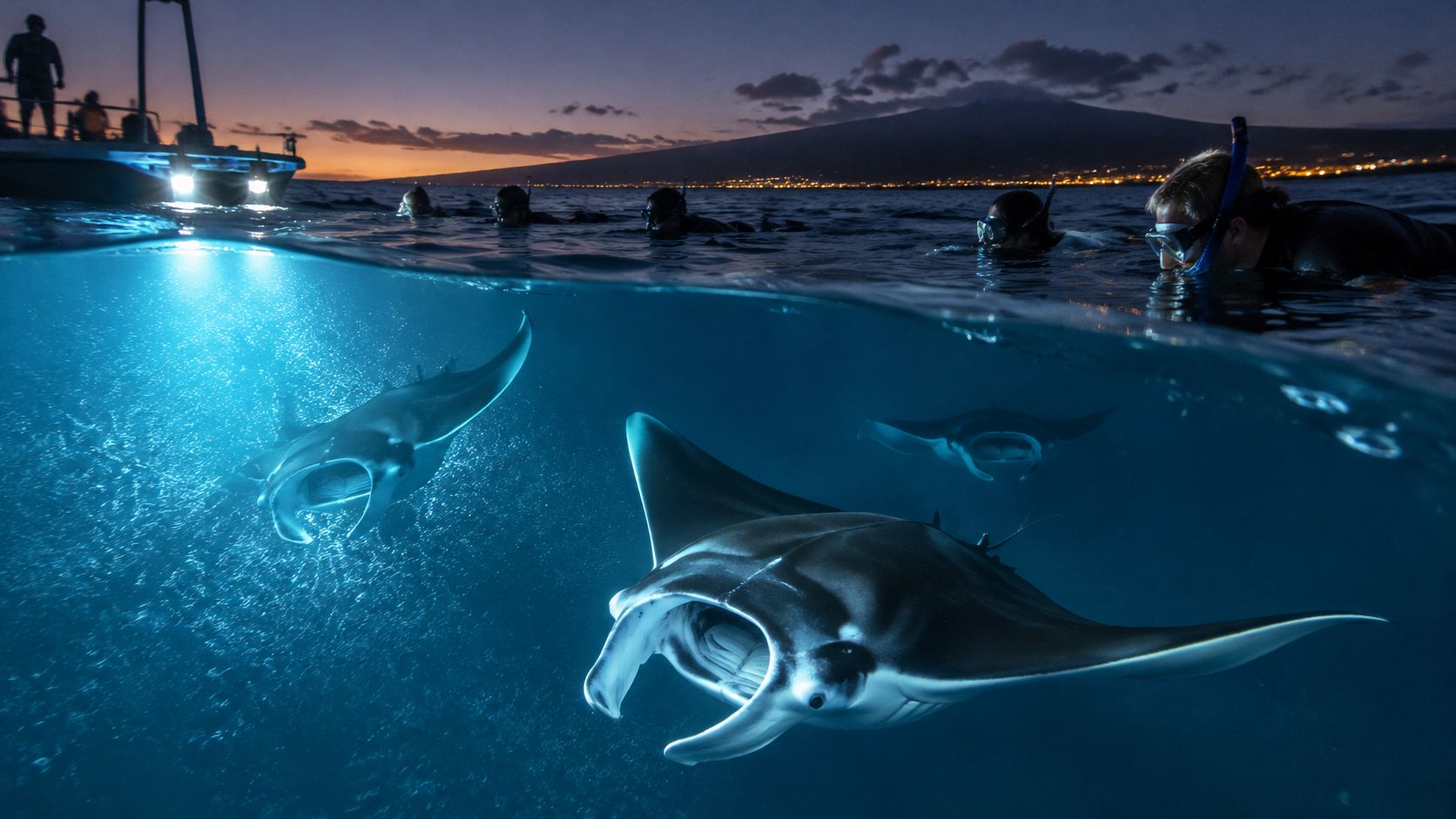
That habit of returning is what a University of Hawaiʻi monitoring study put numbers to. Community-sourced records covering 13 years, from 2010 through 2022, produced more than 23,000 sightings of 167 individually identified reef manta rays at Garden Eel Cove and Keauhou. An animal doesn't appear 23,000 times in one dataset by passing through.
The two sites don't behave identically, either. Garden Eel Cove consistently supported larger aggregations, while Keauhou showed stronger female use and high female site fidelity. Across both locations the sex ratio came out at roughly 1:1, although the distribution differed by site, and the study found indications that males are more mobile than females.
Reliability comes from residency, not from chum. Nobody feeds these animals. They're eating plankton the lights concentrate, at a site they already know.
What decides the size of the crowd above the lights is food. Seasonal and annual changes in aggregation size tracked zooplankton density, which makes prey availability the primary driver of manta presence rather than the number of visiting boats or divers. That's the honest version of the reliability story. Some nights are quieter, and it's the plankton that decides, not the crew.
Because these animals are residents rather than migrants, there's no month when the site empties out. The best time to see the manta rays in Kona comes down to sea state and your own calendar rather than a migration window.
Kona manta population and sighting figures
| Measure | Figure | Source context |
|---|---|---|
| Effective population size, Hawaii Island | 104 (95% CI 99-110) | Hawaii-focused genetic study |
| Effective breeders, Maui Nui | 129 | Same genetic study |
| Individual reef mantas photo-identified on the Kona coast, 1992-2007 | 106 | Earlier photo-identification work |
| Individual reef mantas identified, 2010-2022 | 167 | University of Hawaiʻi monitoring study |
| Sightings analyzed, 2010-2022 | More than 23,000 | Community-sourced records at Garden Eel Cove and Keauhou |
| Sex ratio across both sites | Approximately 1:1 | Same monitoring study |
The top two rows are the ones that change how you think about the night. They count animals capable of contributing genes to the next generation, not animals you might see on a given evening, and they describe a population with very little room for losses. Slow maturity and infrequent reproduction do the rest of the arithmetic. A boat strike or an entanglement in a group this size isn't a rounding error.
How the Night Dive Works and How to Stay Safe
The dive is shallow, stationary and light on technique. Almost everything that goes wrong on it goes wrong because somebody moved.
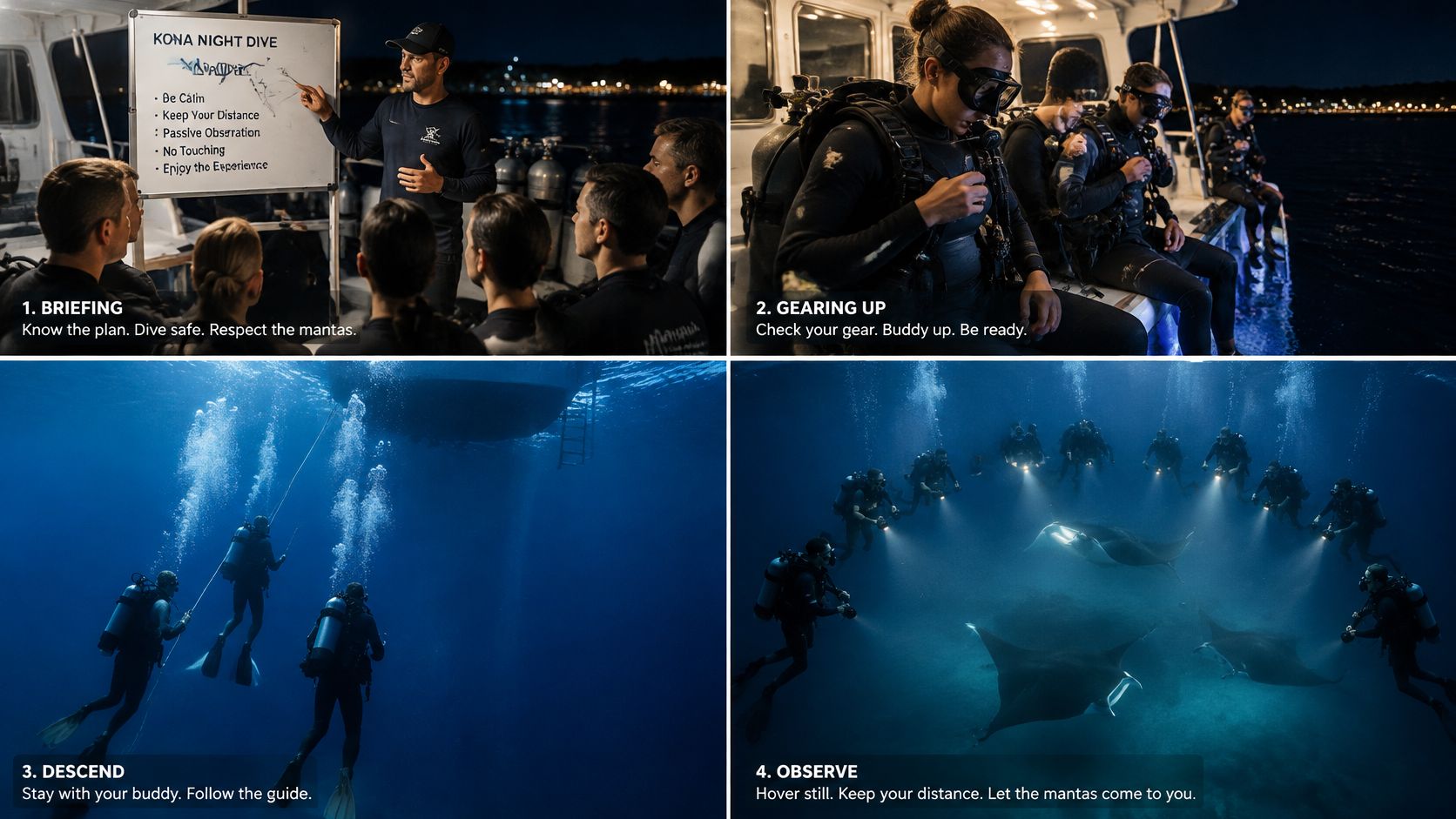
The Six Steps From Boat to Sand
- Sit through the briefing with your hands empty. Crews cover the science of what you're about to see and the rules of passive observation, and on our boat that briefing isn't a formality. Understanding why the mantas are there is what stops you from getting in their way.
- Gear up and enter with a guide. At night you lose your surface reference and the group is harder to read. Our divemasters and instructors are in the water with divers for the whole dive, and entering together keeps everyone in one place from the first fin stroke.
- Settle on the sand and stop moving. Kneel low, trim your weighting so you can hover a hand's width above the bottom, and keep your fins still. Our dive lights put a bright circle on the seafloor, so you're never kneeling in real darkness, but sand you kick up hangs in the beam and dulls the light field for the whole group.
- Let the light field build. Reef manta rays are filter feeders, and the NOAA manta ray work product explains the mechanism: artificial dive lights concentrate plankton in the water column, and the resulting prey patch can trigger repeated feeding passes, including barrel rolls through the brightest plankton-rich zone. Mantas often feed at night because zooplankton migrate upward, which is why you see rays rise from deeper water. Lights raise the odds of a feeding opportunity without guaranteeing that mantas appear.
- Watch with your hands at your sides. Rays routinely sweep within arm's reach of a kneeling diver, and the temptation to reach out is real. Keep hands down or folded at your chest and let the animal choose the distance.
- Leave on the guide's signal. Ascend slowly with the group, watch your computer, complete your safety stop and switch on your light at the surface so the boat can track you.
The Rules That Carry Fines
Hawaiʻi law treats manta rays as protected in state marine waters. Under Hawaiʻi Revised Statutes §188-39.5, capturing, possessing, abusing or entangling a manta ray is prohibited, and the penalties reported by the Big Island visitor guide run from a $500 fine for a first offense up to $10,000, with an additional administrative fine of up to $10,000 per animal.
The rule that matters most: look, don't touch. A manta's skin carries a mucus layer that works as its immune system, and a hand or a stray fin across it leaves the animal exposed to infection.
Chasing, grabbing and riding are all barred for the same reason, and they end the encounter anyway. A manta that's being followed leaves.
Your Own Safety, Which Nobody Else Can Manage
Personal risk on this dive is mostly medical and mostly preventable. If you have asthma, a heavy cold, a history of ear trouble or any condition your doctor has flagged, get cleared before you book, because open water at night is a poor place to discover a problem. Take seasickness medication 30 to 60 minutes before departure rather than when the queasy feeling starts.
Buoyancy is the skill that protects you and the animals together. An overweighted diver kneeling on sand stirs a dust cloud, runs through air and drifts into the diver beside them. Night work is a different skill set from the daytime version, and scuba diving at night is worth a refresher if it's been a while, even on a dive this shallow.
A good night isn't the one with the most mantas over the light. It's the one where three or four animals make repeated, close, unhurried passes above a group of divers who never moved.
Why Garden Eel Cove Is the Superior Dive Site
Two sites host most Kona manta evenings, and if you're choosing a trip, choose the one that puts you in a protected cove with a defined viewing area. That's Garden Eel Cove.
Its value is physical rather than romantic. The protected location provides a defined viewing area where divers can settle below the feeding lane, so you hold a fixed position instead of drifting in open water while the group spreads out behind you. The surrounding reef habitat adds structure to the experience, which matters more than it sounds on a dive where you spend the bulk of the time looking up.
The site sits west of Kona International Airport inside the West Hawaiʻi Ocean Recreation Management Area, and as the site profile notes, that protected cove generally offers calmer conditions than a more exposed location. Calm water is a safety feature first and a comfort feature second. A diver who isn't managing surge is a diver who isn't kicking, and a diver who isn't kicking keeps the light field clean.
Why the Reef Still Counts on a Manta Dive
You don't descend straight onto bare sand and leave straight from it. There's a reef around the cove, and it gives the group something to look at on the way in and out while the light is being set. On a two-tank format that reef work becomes half the trip rather than a transit corridor, and it's the reason a cove beats a featureless patch of sand.
The One Question That Sorts Operators
Ask which site the boat runs to, whether that site has a defined viewing area, and what the crew does when the sea state turns. A good answer names a specific place in one sentence. A weak one talks about conditions and flexibility without naming anything.
Three signals tell you the answer is real:
- A named site. Garden Eel Cove is named, not implied, and we run our manta charter there because the cove gives us the positioning we want.
- A described viewing area. The crew can tell you where you'll kneel relative to the light and where snorkelers will be on the surface.
- A stated fallback. Weather still moves the plan on any given night, and an operator who says so up front is telling you the truth about the ocean.
Prefer the operator whose answer points to a protected cove, a defined viewing area and calm water. The rest is scheduling.
How Crowding Affects Safety and the Animals
Crowding is the question this dive gets asked least and deserves most. Trip descriptions sell visibility and close encounters, and almost none of them explain what happens when eight boats share one patch of water.
A Hawaiʻi Department of Land and Natural Resources boating assessment identified substantial operational risks tied to nighttime activity around manta-viewing sites. Observations cited in Hawaiʻi tourism-regulation research recorded roughly 16 to 19 vessels and 160 to 190 people in the water at the same time, and another observation logged 21 vessels and 301 people. Read those numbers as a description of surface traffic, engine noise, competing light fields and a lot of bodies in one small area.
Stability and safety aren't the same thing. A resident population can hold steady under sustained tourism while individual nights still carry collision risk at the surface, divers separated from their guide, and encounters spoiled by twenty people kicking in a beam. Responsible capacity looks like fewer boats on station, a stated maximum group size, engines off once you're moored, and a guide who keeps the group together.
Fewer boats around the light means calmer mantas and a dive you can actually watch. Those two things tend to arrive together.
Three checks before you book: how many guests ride on the boat, how many vessels the operator expects to share the site with, and whether the crew will move away if it gets busy. Add a fourth for your own conduct, because a group that follows responsible diver etiquette is easier to supervise and less likely to scatter into the feeding lane.
Pack, Photograph and Time Your Night Dive
The gear list is short. The timing is what people get wrong.
What to Bring
- Wear your swimsuit under your clothes. Less changing on a moving boat at dusk is always better.
- Bring a warm layer for after the water. A wet skin and a night breeze on the ride back feel colder than the air temperature suggests.
- Apply reef-safe sunscreen before you leave, not on the boat. Once you're in a wetsuit, half of your back never gets covered.
- Pack a dry bag for phone and camera. Spray finds everything that isn't sealed.
- Carry your own medication and tell the crew where it is, especially if it's inhaler or seasickness related.
Photography That Doesn’t Ruin the Dive
No flash. The dive lights are the light source and a strobe blinds the animal and flattens the scene. Set a high ISO with a wide aperture, somewhere around f/2.8 if your lens allows it, and let the shutter do the work. Shoot from above the ray rather than from below, since a top-down frame catches the whole wingspan against the lit water. Brace the camera against your chest or the sand, because a photographer who swims after an animal changes the encounter for everyone behind them. If you want a reference for the frames the light gives you, these manta ray dive pictures from Kona show the difference between shooting into the beam and shooting across it.
Timing Your Evening
Night dives run well after dark, so build the day around them. Take a late afternoon nap, eat a light meal an hour or two before departure, and avoid flying the same day if you're diving on scuba. Keep one flexible date open if you can, because sea state and visibility call the schedule and a rough night isn't worth forcing. If the crew offers to reschedule, take it.
Book Your Manta Ray Night Dive with Kona Honu Divers
Most of what separates a smooth manta night from a frustrating one is settled before you step onto the dock, and it's settled by the answers an operator gives you before you pay.
Booking questions and what the answer reveals
| Question | Why It Matters | What a Good Answer Looks Like |
|---|---|---|
| How many guests per boat? | Crowding affects safety and manta behavior | A stated maximum and typical group size |
| What is the guide-to-guest ratio? | Divers need supervision in the dark | Guides or instructors in the water with the group |
| When do engines run? | Surface traffic and noise near feeding mantas | Engines off once on station |
| Where are the lights placed? | Light over the seafloor concentrates plankton | Lights aimed upward from the sand, not at the animals |
| What happens if conditions change? | Sea state and visibility can cancel a dive | A clear reschedule or refund policy |
| Is the operator permitted for commercial manta viewing? | The state requires a specific commercial permit | Permit confirmed on request |
That last row isn't a formality. Commercial manta tours in Hawaiʻi's designated manta-viewing zones require a specific commercial permit from the state Department of Land and Natural Resources, as the department's permit document sets out, which means manta viewing is regulated rather than open access. It also means a properly permitted operator can tell you exactly which zone it runs and why.
Kona Honu Divers runs the Manta Ray Night Dive to Garden Eel Cove, with the lights placed on the sand, guides in the water and a briefing on the science before you get wet. There's also a 2-tank manta dive and snorkel format that pairs a guided reef dive with the night manta segment, which suits divers who want a full afternoon and evening on the water rather than a single descent. Certification minimums, group limits and charter details are set by the operator, so confirm yours when you reserve.
If you want to see how the manta night fits into a longer stay, the full selection of Kona diving tours covers morning reef trips, blackwater nights and advanced charters, so you can compare formats before you commit to a date.
Reserve the evening you want as soon as your travel dates are fixed, since the good nights fill first, and call the shop the afternoon before to confirm the go/no-go.
Kona Honu Divers runs the Manta Ray Night Dive at Garden Eel Cove, with guides in the water, lights on the sand and a briefing that explains the animals before you meet them, plus a 2-tank manta charter for divers who want a reef dive first. Small-group positioning and passive observation are the whole point, and they're what make a resident population of a few hundred animals worth traveling for. Hold your date through Kona Honu Divers and keep one spare evening open in case the ocean has other plans.