
You've probably looked at a few photos already: a manta gliding over a diver, a transparent creature suspended in black water, a lava arch disappearing into blue. The practical question is harder. Which Kona dive fits your experience, your comfort in the water, and the kind of marine life you want to observe?
Kona diving rewards preparation. The coast offers calm reef sessions, advanced volcanic terrain, manta encounters built around predictable feeding behavior, and blackwater dives where the open ocean replaces the seafloor. It also demands restraint. The best dives happen when divers understand the conditions, control their equipment, and give animals room to behave naturally.
Why Kona is a Global Scuba Destination
The first sensation is usually space. You descend beside dark volcanic rock, the surface fades above you, and the water opens into a blue field filled with reef fish, turtles, arches, and narrow lava passages. Along the west coast of Hawaiʻi Island, ancient lava flows created underwater structures that feel less like a conventional tropical reef and more like a submerged volcanic formation.
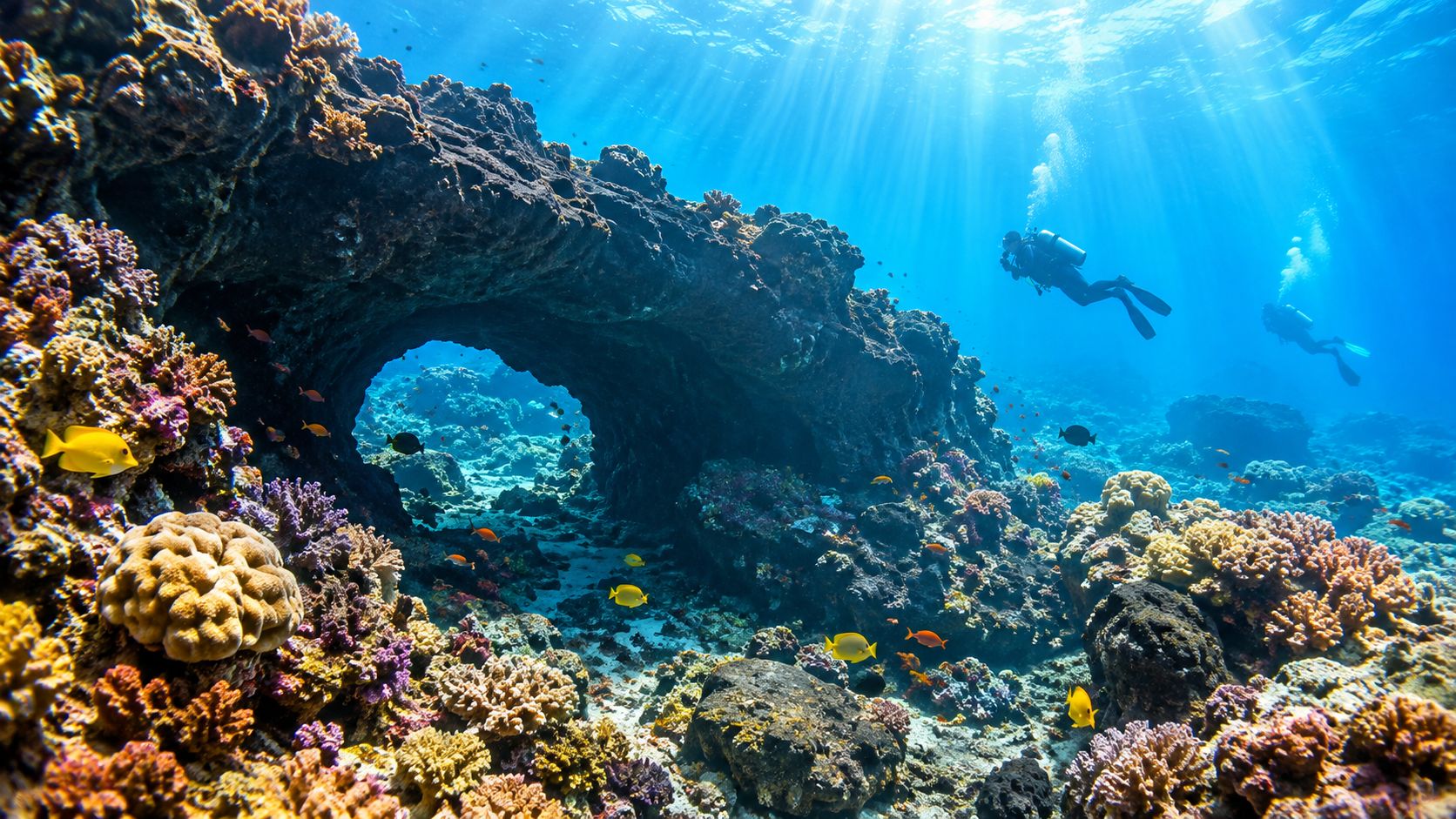
Kona's appeal comes from the proximity of contrasting habitats. Protected bays allow calm entries and comfortable observation, while steep underwater terrain leads toward deeper water close to shore. That combination gives a diver access to shallow reef life on one dive and open-ocean conditions on another without treating them as the same experience.
The coastline's volcanic geology also shapes how crews choose sites. Lava tubes, ledges, arches, boulder fields, and drop-offs each create different shelter and feeding opportunities. A site with a broad sandy area may suit a controlled manta viewing formation, while a more complex lava structure rewards an experienced diver who can maintain buoyancy without touching the reef.
Conditions that reward planning
Kona is known for clear water and generally favorable surface conditions, but no coastal dive is guaranteed to feel identical from one day to the next. Wind, swell, current, surge, and recent weather affect visibility and entry conditions. Boat crews can move between sites, while shore divers need to judge the entry and exit before committing to the water.
Marine life also changes with the site and time of day. Daytime reef dives focus on the animals and structure around the seafloor. Night dives shift attention toward feeding behavior, while blackwater dives leave the reef entirely and place divers in the open water column.
Practical rule: Choose the dive for the conditions and your actual skills, not only for the photograph you saw online.
For a broader overview of the volcanic coast, habitats, and planning considerations, see this Kona scuba diving guide. The right itinerary usually includes variety, but variety only works when each dive matches the diver's certification, buoyancy, and comfort in the environment.
Top Reef and Advanced Dive Sites
Kona's daytime diving has more range than the manta briefing often suggests. A morning boat trip may visit a shallow lava formation with easy navigation, or it may head toward deeper pinnacles and less forgiving terrain. The useful distinction isn't just “beginner” versus “advanced.” It's whether the site lets you maintain control while handling depth, current, navigation, and the possibility of limited reference points.
Reef structure for developing divers
Shallow volcanic formations provide a forgiving introduction to the coast's character. Lava arches and tubes create natural swim-throughs, but divers should treat every overhead-looking feature seriously. A passage is appropriate only when it has a clear entry and exit, sufficient space, and conditions that don't require contact with the rock.
Coral growth occupies the harder lava substrate, and cracks and ledges shelter fish, eels, octopus, and other reef animals. Hawaiian endemics can appear alongside familiar tropical species, while green sea turtles often use protected reef areas for resting and feeding. The correct technique is simple but important: stay neutrally buoyant, keep fins away from the bottom, and use your eyes before your hands.
When advanced terrain makes sense
Deeper pinnacles, exposed walls, and sites with more complex navigation suit divers who can manage gas, depth, buoyancy, and a controlled ascent without constant intervention. A diver who is relaxed at a shallow reef may still need more experience before choosing a site where the bottom drops away, the current changes around a structure, or the group must remain together in blue water.
Advanced trips can also reach areas that aren't practical from shore. That access is useful, but remoteness isn't automatically a reason to go. The main advantage is the crew's ability to select a site that fits the group and adjust the plan when conditions change.
Use this Big Island dive-site guide when comparing daytime options, then ask the operator direct questions:
- Depth and profile: What depth range is expected, and how much of the dive involves a wall or open-water descent?
- Entry and exit: Does the site require a giant stride, a ladder exit, or a surface swim?
- Current and navigation: Will the group follow a reef contour, a line, or a guide?
- Recent experience: Is a refresher sensible if you haven't dived recently or don't feel sharp underwater?
A good site briefing should explain the terrain, not just name the location. If you can describe where you'll descend, where you'll turn, and how you'll return to the boat, you're preparing for the actual dive rather than buying a label.
The Science and Etiquette of Manta Night Dives
The Kona manta dive works because the animals repeatedly use known feeding locations after sunset. Divers don't chase mantas across the coast. They sit in a controlled observation area while lights concentrate plankton in the water column, creating a feeding opportunity that the rays may choose to use.
Garden Eel Cove, also known as Makako Bay, is the superior choice for this dive when conditions permit. Its protected location and bottom layout give divers a defined viewing area, while the reef and substrate allow the group to remain low and leave the open water above available to the mantas. Divers should settle on sand, rubble, or boulder substrate, form a loose semi-circle, and keep the viewing corridor open.
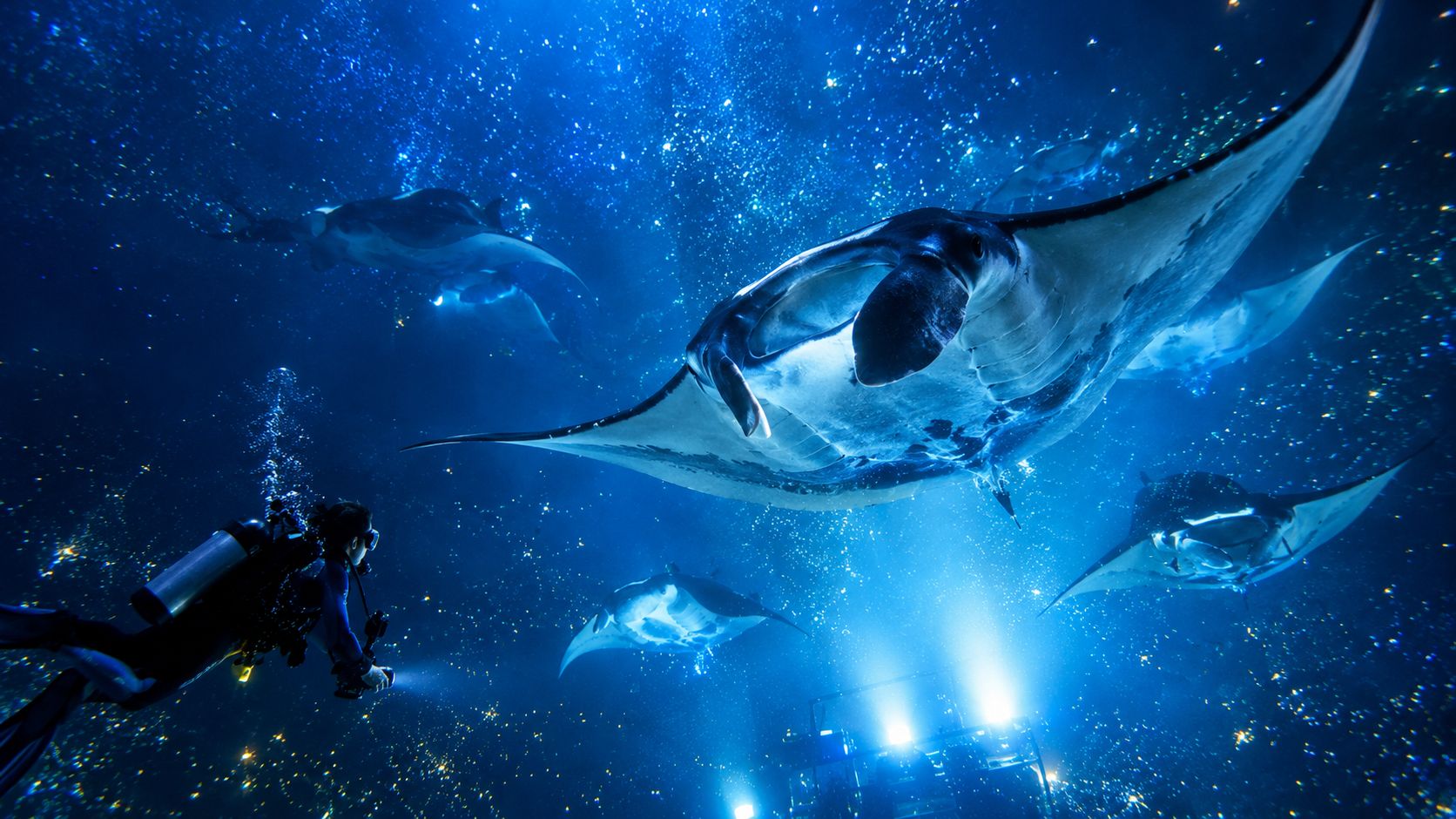
A NOAA-hosted study analyzed observations from 2009–2014 and recorded 25,444 sightings involving 118 identified reef manta rays, with substantial variation in movement behavior and a statistically significant difference in site use between males and females (NOAA-hosted manta-ray study). Researchers identify individuals by their ventral spot patterns, which means a good encounter can contribute to long-term, noninvasive population monitoring when images are collected responsibly.
Why position matters
Divers remain near the bottom and point lights upward. Snorkelers stay at the surface and direct lights downward. This separation leaves the feeding zone open between the two groups and gives mantas room to turn, bank, and pass without being surrounded.
Follow four rules throughout the encounter:
- Stay still: Let the manta approach rather than swimming toward it.
- Keep hands off: Touching, grabbing, riding, or blocking a ray interferes with natural behavior and is illegal under Hawaiʻi law.
- Control your light: Aim the beam into the plankton-rich water, not directly into an animal's face.
- Protect the bottom: Avoid coral, other marine life, and fin contact with the substrate.
Hawaiʻi law prohibits capturing, taking, possessing, abusing, or entangling rays. Reported penalties range from $500 for a first offense to $10,000, with an additional administrative fine of up to $10,000 per animal (Hawaiʻi ray protection information). The legal rule reflects the biological rule. A manta isn't a prop in a staged performance. It's a wild animal deciding whether to use the feeding area.
The dive's probability can be high without guaranteeing a particular number of animals, behavior, or duration. Weather, crowding, plankton distribution, and individual choice still matter. Read this responsible diver etiquette guide before entering the water, and treat patience as part of the experience.
Exploring the Pelagic Zone on Blackwater Dives
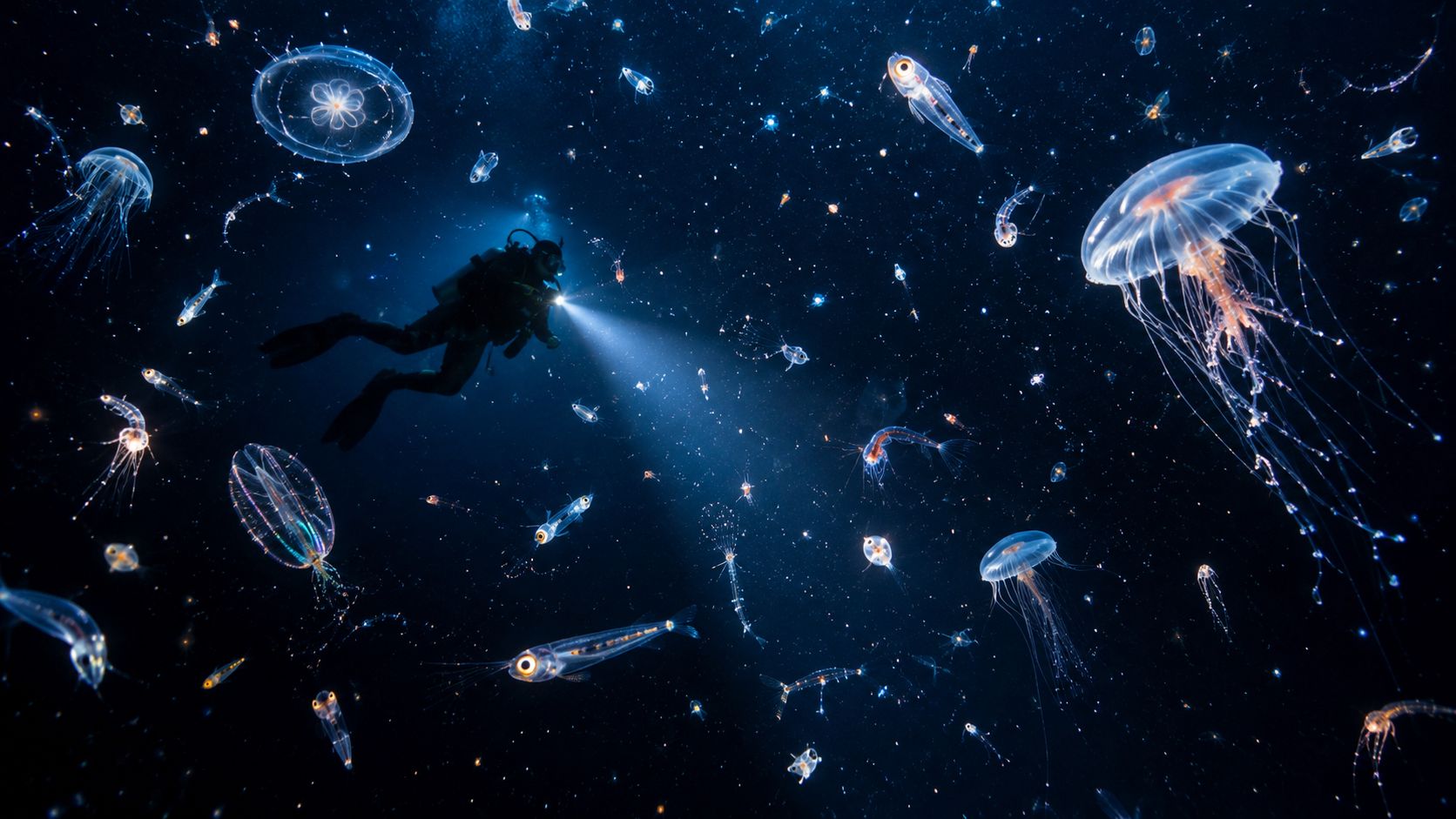
A blackwater dive has no reef to follow and no seafloor to use as a visual reference. Divers enter the open ocean at night, maintain position around a lighting system, and watch organisms moving through the water column. The experience feels quiet and expansive because the subject isn't a fixed backdrop. The subject is migration.
Open-ocean organisms rise and descend as part of a nightly vertical movement tied to feeding. Salps, siphonophores, ctenophores, larval fish, and other transparent or delicate animals can appear in the light field. Some are so small or visually subtle that the diver needs to stop scanning for large animals and learn to notice motion, edges, filaments, and faint internal structure.
Why the dive matters to marine science
Kona blackwater diving has supported direct observation and collection of pelagic life. A NOAA-backed study collected 76 specimens during blackwater dives and analyzed each through COI DNA barcoding, identifying salps, siphonophores, and ctenophores as the most abundant organisms in visual-census observations (blackwater diving research).
That research connection changes how I evaluate the dive. The point isn't to collect a dramatic photograph at any cost. It's to observe a fragile community without damaging it, and to understand that recreational divers can operate inside a setting useful to structured biodiversity work.
The practical protocol is strict:
- Buoyancy comes first: Hold a stable depth without sculling or repeated corrections.
- Use redundant illumination: Carry a primary light and a backup that you can operate confidently.
- Respect the tether or group system: Treat it as your reference and remain aware of the line, boat, and other divers.
- Don't pursue animals: Let the light field bring subjects into view.
- Stay conservative: Monitor gas, depth, no-decompression status, and ascent planning continuously.
Blackwater is not a suitable first night dive. It suits divers who can remain calm without a bottom, manage equipment in darkness, and accept that the most memorable subject may be smaller than a fingernail. The reward comes from attention rather than distance covered.
For trip details and experience requirements, review the Kona blackwater dive information. If your buoyancy is inconsistent on a normal reef, more practice will improve this experience far more than buying another camera accessory.
Critical Safety Protocols for Surface and Freediving
Shallow water creates a dangerous illusion. A swimmer can see the surface, stand on the bottom, and still suffer a fatal breath-hold event. Swimming ability helps with movement and self-rescue, but it doesn't remove the physiological risk of holding your breath after repeated dives.
A Hawaiʻi-focused report states that at least 58 people died while freediving between 2014 and 2025, with shallow-water blackout identified as a leading cause of fatal drownings among Hawaiʻi residents (Hawaiʻi freediving safety report). The critical point is that blackout can occur near the surface, often during ascent or immediately afterward, when the diver may appear to be almost safe.
Breath-hold habits that increase risk
Hyperventilating before a breath-hold can suppress the normal urge to breathe without providing a safe increase in available oxygen. That delay can make a diver feel capable of staying down longer while reducing the warning that normally prompts a return to the surface.
Repeated dives create another problem. Fatigue, excitement, competition, sun exposure, dehydration, surge, and current all increase the margin for error. Depth contests and attempts to extend bottom time turn a recreational swim into a performance test without the supervision and preparation that performance requires.
A buddy must actively watch the diver, especially during the final part of the ascent and at the surface. Swimming nearby isn't enough. The watcher needs to know the planned depth and time, maintain position, and be ready to support the diver immediately.
A strong swimmer can still black out. Treat every breath-hold dive as a supervised activity, not a solo skill demonstration.
Scuba and breath-hold rules are different
Scuba divers must never hold their breath during ascent because expanding gas can cause serious injury. Freedivers face a different risk profile. They need surface-focused supervision, conservative limits, and a strict refusal to hyperventilate or compete.
Kona conditions can compound the risk. Surge makes it harder to rest at the surface, boat traffic reduces situational awareness, and unfamiliar masks or fins can cause extra effort. Families, new swimmers, and anyone feeling tired or anxious should choose a guided snorkel setting, stay on the surface, or leave the water. A shallow reef isn't automatically safe, and a short breath-hold isn't automatically harmless.
Logistics and Choosing the Right Dive Operator
Boat diving and shore diving solve different problems. A shore entry gives experienced divers flexibility, but the diver owns the entire decision, including weather assessment, entry timing, navigation, equipment transport, and exit. A boat trip costs more effort to schedule, yet the crew can choose among sites and handle the surface logistics.
For many visitors, the boat is the more practical option. Volcanic entries can be awkward, and a site that looks calm from the parking area may have enough surge to make entry or exit a poor choice. Boat crews also know which reef structure suits the group's certification and recent experience.
What to evaluate before booking
Don't choose only by the destination name. Ask how the operator manages the details that affect the dive:
- Boat design: Look for stable boarding, shaded seating, organized equipment storage, and a crew that can assist without rushing.
- Equipment care: Rental regulators, buoyancy systems, computers, lights, and exposure protection should be inspected and proactively serviced.
- Briefing quality: The crew should explain the site, depth, entry, exit, lost-buddy procedure, and wildlife etiquette.
- Trip variety: A useful operator can match a new diver to a reef, an experienced diver to more challenging terrain, and a properly qualified guest to a specialized night dive.
- Conservation behavior: Guides should control diver positioning and correct touching, chasing, or unsafe photography instead of rewarding it.
Kona Honu Divers offers two-tank morning reef trips, advanced outings, manta night dives, blackwater excursions, courses, rentals, and private charters. Its stated equipment setup includes spacious boats, hot showers, shaded seating, storage, proactive rental-gear servicing, and free nitrox for appropriately certified divers. Visit the Kona diving tours page to compare the available formats and requirements.
Build a realistic itinerary
Schedule the signature dive only after considering the rest of your trip. A manta night dive asks for calm attention after dark. A blackwater dive asks for stronger buoyancy and open-water self-reliance. An advanced reef trip may be technically straightforward for one diver and stressful for another who hasn't dived recently.
Tell the crew about your last dive, current certification, comfort with night diving, and any equipment concerns. A good operator can often improve the experience by changing the site or recommending a refresher. A bad booking strategy is to hide uncertainty because you fear being turned away. The crew needs accurate information to keep the group safe.
Gear Requirements and Underwater Photography Tips
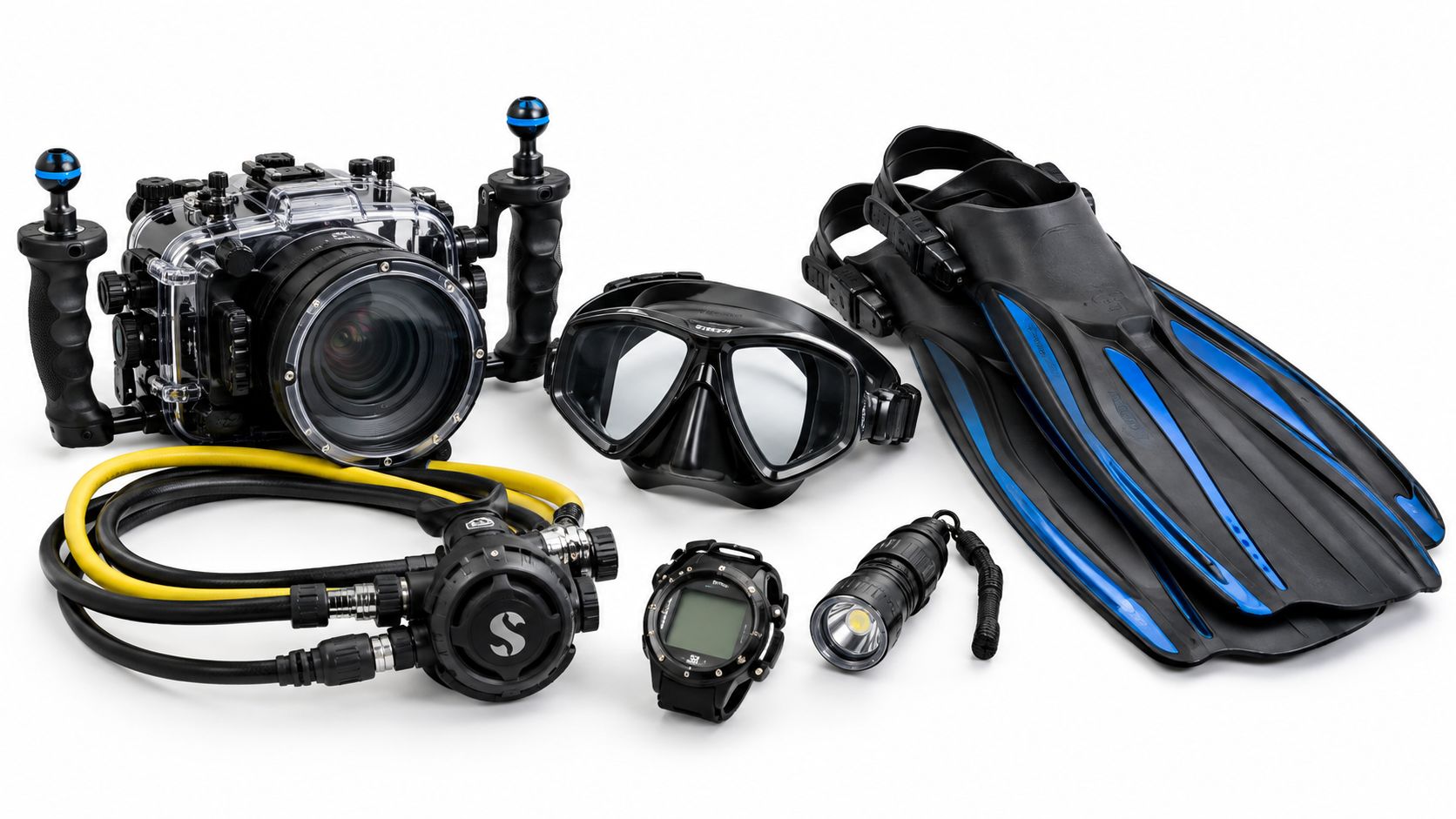
Good Kona diving gear is the equipment you can operate without thinking. A well-fitting mask matters more than an expensive mask. A dive computer you understand matters more than a feature-heavy model you haven't used. Rental equipment should be clean, correctly sized, and serviced proactively, while personal items should be familiar and reliable.
Pack for control, not clutter
Bring a mask that seals, exposure protection suited to your comfort, a dive computer, and a surface signaling device if your operator requires or recommends one. For night diving, carry a primary light and a dependable backup. Check batteries before boarding, and clip lights where you can reach them without disturbing your trim.
Photographers should solve buoyancy before adjusting camera settings. A camera is a poor reason to kneel on coral, grab a rock, or swim after an animal. For mantas, compose from the stationary position and allow the ray to enter the frame. Preserve a clear path, avoid touching the bottom, and follow the crew's lighting rules.
Blackwater photography needs a different mindset. Subjects move in three dimensions and may rotate, drift, or disappear outside the beam. Use a stable position, keep your light controlled, and accept missed frames. Chasing a delicate animal wastes gas, disturbs the viewing area, and usually produces a worse image than waiting.
For a practical equipment checklist before buying or renting, use this guide to scuba gear for beginners. The best upgrade is often practice with the equipment you already own.
Photographer's rule: If getting the shot requires touching the reef or pursuing the animal, the shot isn't worth taking.
Kona Honu Divers offers guided reef, advanced, manta, and blackwater trips with serviced rental gear, experienced instructors, and boats equipped for comfortable day and night operations. Visit Kona Honu Divers to choose a dive that matches your certification, buoyancy, and interest in responsible marine-life observation.