
You've got a few open days on the Big Island, a certification card or an interest in trying scuba, and a growing list of reefs and manta trips to compare. The difficult part isn't finding a dive. It's choosing one that matches your skills, your travel companions, and the conditions you'll encounter.
For diving Kona, Big Island, start with the entry and the dive format, not the clearest-water photograph. A comfortable reef dive beats a difficult shore entry, and a responsible manta encounter is worthwhile without treating wildlife sightings as a promise.
Kona’s Top Dive Sites at a Glance
Top Kona dive sites by dive type and entry
| Site | Dive type | Best for | Entry |
|---|---|---|---|
| Garden Eel Cove | Manta viewing and reef dives | Protected viewing area with strong reefs | Boat, or locally assessed shore access in suitable conditions |
| Manta Village, Kaukalaelae Point | Night manta viewing | Photo-identification of reef mantas | Guided boat trip |
| Manta Heaven, Makako Bay | Night manta viewing | Highest share of manta sightings in long-term monitoring | Guided boat trip |
| Keauhou | Manta and reef dives | A second manta location for repeat visitors | Guided boat trip |
| Old Kona Airport Marine Life Conservation District | Shore and boat dives over lava structures | Experienced independent divers | Shore entry over sharp coral and lava rock, or boat |
| Deep pinnacles and lava tube sites | Deep, drift and swim-through dives | Advanced certified divers | Boat |
Garden Eel Cove is my preferred starting point for a manta-focused visit. Its protected location, better viewing area, and stronger reefs make it the superior choice for combining stationary wildlife observation with an interesting reef setting. Shore access shouldn't be interpreted as an invitation to attempt an unfamiliar nighttime entry.
The manta names need some untangling before you book. Garden Eel Cove and Manta Heaven refer to the same northern viewing area, while Manta Village and Keauhou describe the southern encounter area. These aren't four independent chances at different manta populations.
In a study covering observations collected from 2009 through 2014, Manta Heaven accounted for approximately 78% of recorded observations across the two monitored sites, according to the NOAA-hosted Kona reef-manta study. That historical share isn't your personal probability of seeing a manta tonight.
Choose access before scenery
Old Kona Airport suits divers who can assess a rocky entry, find their way independently, and plan a realistic exit. Use this Big Island shore-diving guide to evaluate access rather than assuming every shoreline park offers an easy launch.
Deep pinnacles and lava formations belong later in the decision process. Choose them for the skills you want to use, not because deeper sounds more adventurous. An open arch and a confined lava passage also demand different decisions about overhead clearance.
Site-selection rule: Choose the site you can enter, dive, and exit comfortably under today's conditions.
Compare the full range of diving tours, then match your preferred format to your certification and recent experience before committing to a named site.
Dive Types, Certification and Requirements
Kona dive types by time, certification and challenge
| Dive type | When it runs | Minimum certification | Depth or challenge |
|---|---|---|---|
| Introductory scuba dive | Morning | None | Shallow dive with an instructor |
| 2-tank morning reef dive | Morning, two dives | Open Water Diver from PADI, SSI or NAUI | 60 ft (18 m) with a buddy; coral gardens, lava tubes and arches |
| Manta night dive, scuba | After dark | Open Water Diver | Shallow viewing, darkness and stationary positioning |
| Snorkel manta night viewing | After dark | None | Surface viewing and comfort in open water |
| Blackwater night dive | After dark, over deep open water | Certified diver meeting trip-specific experience requirements | Open-water drift with lights and limited visual references |
| Advanced 2-tank trip | Morning | Advanced certification or accepted equivalent | Deeper sites and drift dives; recent experience matters |
| Shore dive, Old Kona Airport | Daylight recommended | Open Water Diver and shore experience | Lava-rock entry and exit |
For most of our regular charters, we require an Open Water Diver certification from a recognized agency such as PADI, SSI or NAUI, allowing diving to 60 feet (18 meters) with a buddy. Bring your C-card. Specialty-trip acceptance also depends on the demands of that trip, so an entry-level card isn't automatic clearance for every format in the table.
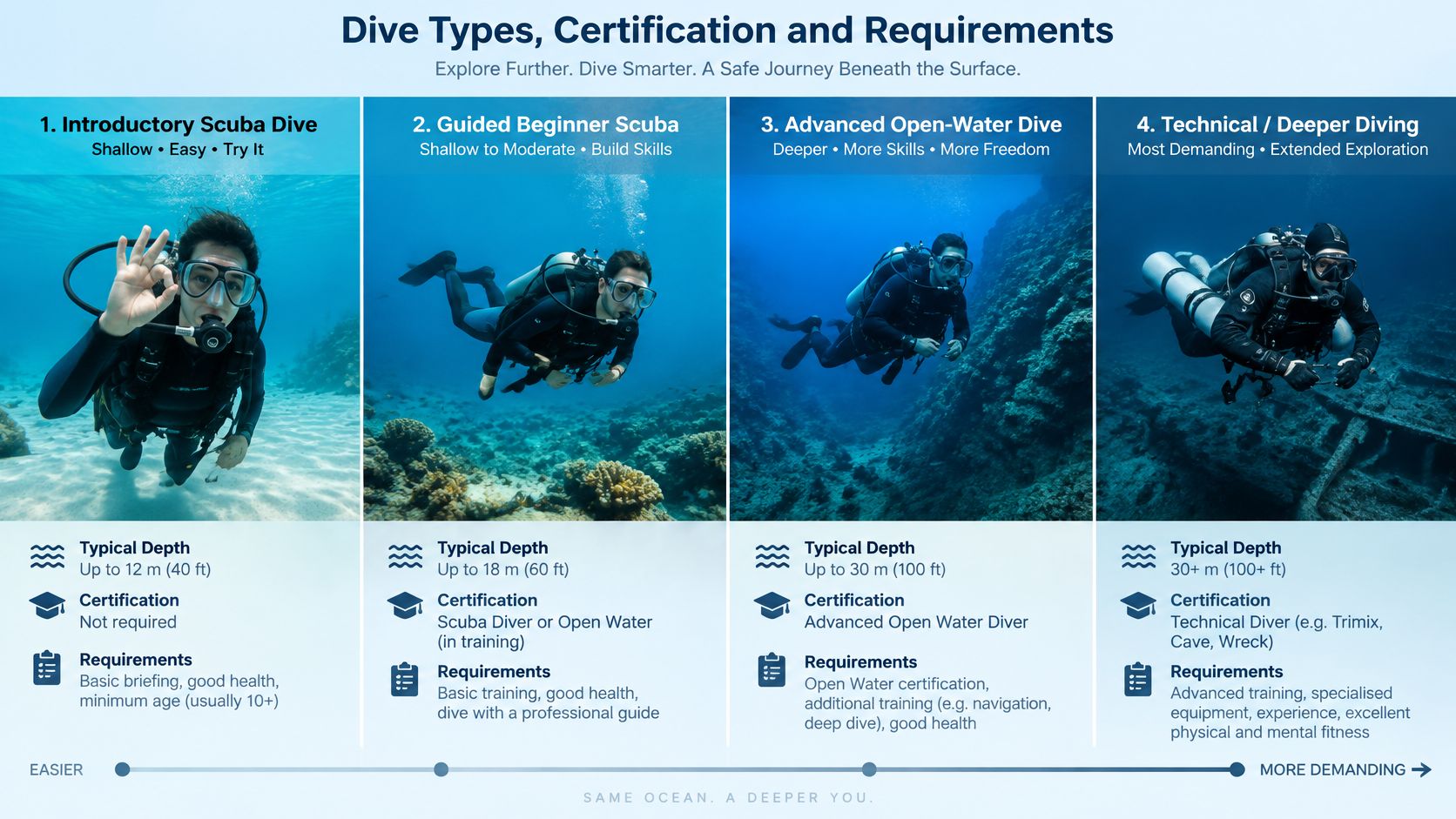
Start with the least complicated environment
An introductory scuba dive gives a beginner direct instruction without requiring an existing certification. It doesn't qualify that person for an independent dive or a certified-diver charter afterward.
For certified travelers, a morning reef trip is the sensible baseline. You can settle weighting, check air consumption, and become comfortable with rental controls while exploring coral gardens and volcanic formations. A lava tube on the itinerary doesn't mean every diver should enter it. Stay outside any overhead environment beyond your training and the guide's approved route.
If your skills feel rusty, arrange scuba instruction or a refresher before adding darkness or current. A relaxed daylight dive is a better skills check than discovering a buoyancy problem beside a crowded nighttime viewing area.
Add challenge deliberately
A manta scuba dive requires calm positioning and awareness of neighboring divers. The snorkel alternative removes scuba management, but participants still need to feel comfortable floating in the ocean after dark. Confirm swimming expectations and suitability for children before choosing it for a family.
The blackwater night dive is a different environment altogether. Divers observe organisms drifting through illuminated open water, without a reef providing familiar depth and orientation cues. Deep water beneath you doesn't mean the planned dive itself is a deep descent.
For deeper terrain and drift diving, consider the premium advanced trip. Certification matters, but so do recent buoyancy control, gas management, and the ability to follow a moving group without chasing it.
Before booking, prepare:
- Certification evidence: Carry your C-card and any relevant specialty credentials.
- Recent history: Have your logbook available and describe your actual comfort level.
- Trip details: Confirm departure time, planned depth, buddy arrangements, and experience requirements.
Independent shore diving isn't necessarily the easier alternative. It transfers entry assessment, navigation, emergency planning, and exit decisions from a boat crew to you and your buddy.
Seasons, Visibility and Water Conditions
Kona conditions by season and weather
The temperature and visibility benchmarks below come from this Kona diving conditions guide: approximately 24–27°C (75–81°F) and 18–30 m (60–100+ ft), with runoff capable of reducing clarity for several days.
| Period | Water temperature | Typical visibility | What changes |
|---|---|---|---|
| Summer, roughly May to October | Within the annual range above | Clear-weather benchmark above | Usually calmer leeward conditions |
| Winter, roughly November to April | Within the annual range above | Clear-weather benchmark above | Swell and wind can change site choice |
| After heavy rain, any season | Choose protection for the actual reading | Reduced after runoff | Sediment increases backscatter |
| Manta night dives, year-round | Confirm the current water temperature | Assess runoff and local exposure | Wind and swell matter more than the calendar |
Read those ranges as planning benchmarks, not daily forecasts. A sheltered bay can look inviting while an exposed lava shelf nearby has enough surge to make an exit difficult. Underwater clarity and surface safety require separate assessments.
Winter deserves flexibility rather than automatic avoidance. A captain may select a different site because of swell direction even when visibility elsewhere remains good. During calmer periods, don't assume a familiar-looking shoreline has no current.
Turn the forecast into a decision
- Check ahead: Review the marine and surf forecast three days before your trip, then keep checking as departure approaches.
- Confirm that morning: Verify the selected boat site or shore entry rather than relying on the original itinerary.
- Dress for immersion: Choose exposure protection for measured water temperature and your tendency to get cold, not the afternoon air temperature.
Photographers should pay particular attention after rain. Suspended particles can spoil contrast and scatter strobe light even when you can still see the reef clearly enough to move through it.
For a manta trip, the practical question isn't which month guarantees animals. It's whether that evening's conditions support a controlled entry, stable viewing, and an orderly return to the boat.
A clear-water forecast isn't permission to use a rough entry.
Keep a backup date and an alternative site in your plan. Don't prepay for a rigid sequence of independent shore dives when a change in swell could make the first entry unsuitable.
Manta Night Dives and How to See Them Responsibly
Manta rays can reach wingspans of 22 feet or more and occur from near the surface to depths of 120 feet or more, according to Hawaiʻi's Department of Land and Natural Resources. Those broad manta measurements aren't a promise about the size of Kona's reef mantas; the agency also identifies the giant oceanic manta, Mobula birostris, as threatened under the federal Endangered Species Act.
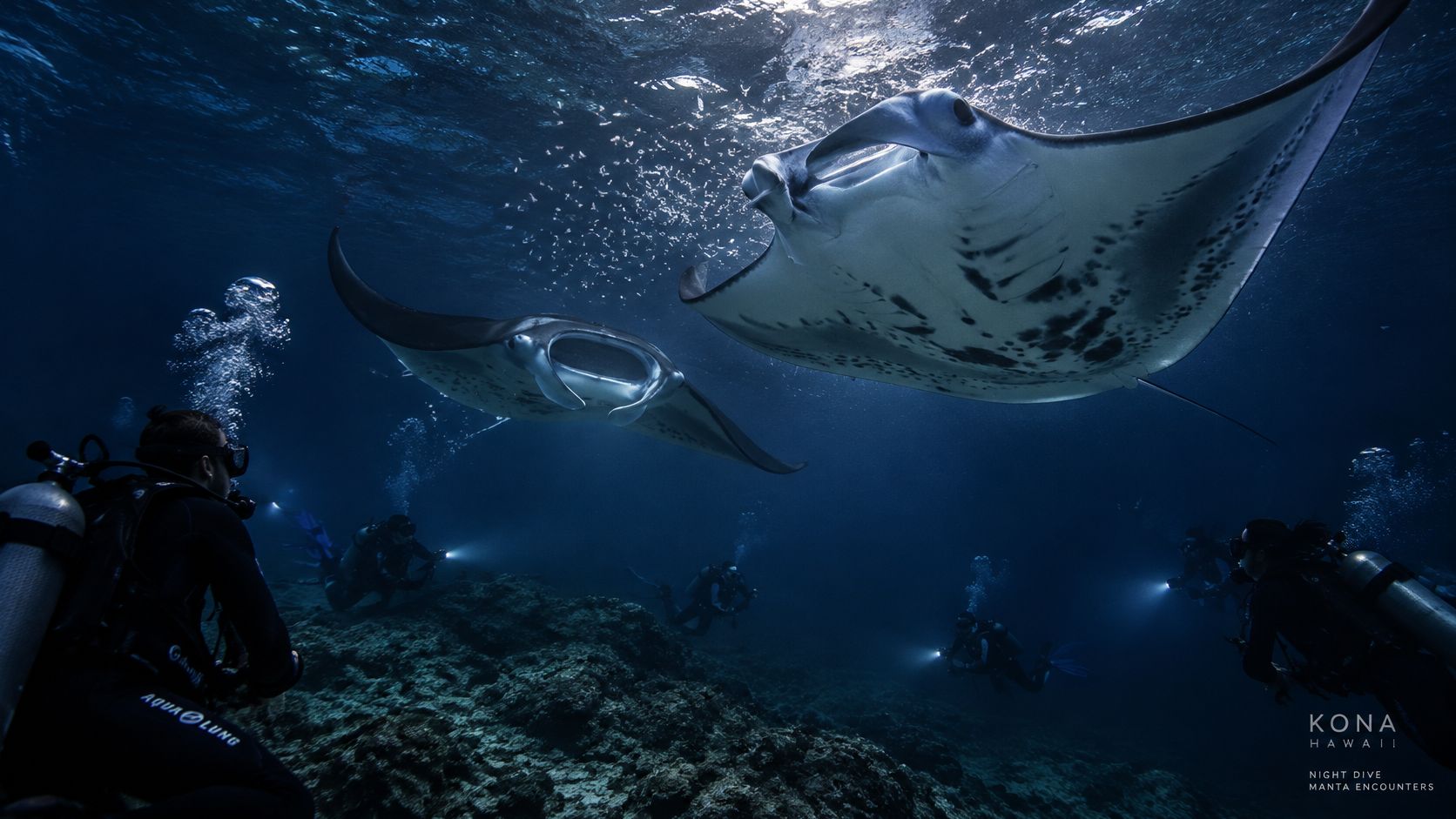
Kona's familiar encounters involve reef mantas feeding on plankton concentrated around lights. A University of Hawaiʻi community-science study found that seasonal and annual aggregation changes tracked zooplankton density. Animals respond to food availability, not a booking confirmation.
Choose your viewpoint, then protect it
Snorkelers watch from the surface without needing scuba certification. This can work for a broad range of ages, subject to swimming ability and trip requirements. Scuba gives certified divers a steadier viewpoint below the action, provided they can maintain position without disturbing the bottom.
Garden Eel Cove is the preferred choice for the manta ray dive tour because its protected location, better viewing area, and stronger reefs support a calmer encounter. Check the night manta dive overview for the format before deciding between scuba and snorkeling.
Use these behaviors in the water:
- Stay still: Let animals choose their route rather than swimming into a feeding loop.
- Leave space: The Marine Megafauna Foundation's manta tourism guide recommends at least 3 meters (10 feet) of separation and a calm, side-on approach when approaching is appropriate.
- Keep hands and equipment clear: Don't touch, pursue, feed, or independently lure mantas.
- Photograph conservatively: Keep flash off near the animals and avoid repositioning into their path.
If a manta closes the distance, remain calm and don't reach toward it. Your job is to avoid causing the close approach, not to make a sudden escape that endangers another diver.
Ask about crowd management and the no-sighting policy before booking. A quieter, controlled encounter is preferable to one where divers compete for position. If no manta appears, let the guide lead an appropriate reef-night observation instead, with no pursuit or search beyond the dive plan.
What to Pack, Rent and Photograph
- Sun protection: Pack reef-safe sunscreen, a rash guard, and a reusable water bottle. Use clothing as your primary sun barrier.
- Exposure protection: Choose a properly fitting suit for Kona's water-temperature range and your own cold tolerance.
- Personal fit items: Bring your mask, fins if practical, and a familiar dive computer.
- Documents: Carry your C-card and logbook, including relevant specialty credentials.
- Night equipment: Arrange a primary dive light and backup, and learn the agreed light signals.
- Surface equipment: Carry a surface marker buoy appropriate to your training.
- Shore footwear: Use booties and sturdy footwear for the approach, without walking across living coral.
Rental fit matters more than luggage savings
A poorly fitted buoyancy compensator can shift around your torso; a loose wetsuit can leave you cold while you're stationary. Try rental equipment before departure and check that you can reach releases, dump valves, and inflation controls without looking.
Ask when equipment was serviced and what the rental package includes. Confirm weights, exposure protection, computer, and lights rather than assuming every accessory comes with the regulator and buoyancy compensator.
Nitrox is enriched air, with more oxygen and less nitrogen than ordinary air. It can extend no-decompression time on suitable profiles, but it doesn't remove depth limits or make every dive longer. Ask whether it's included and whether you need a separate course; analyze your cylinder, record the result, and set your computer correctly.
Photograph the water you have
For reef photographs, shoot wide and get close to the subject without touching it. Reducing the water between lens and subject usually helps more than increasing strobe power.
For mantas, angle upward from your assigned position and let the animal enter the frame. Don't rise into its path to fill the image, and keep flash off near wildlife.
After runoff, start with lower strobe power and position strobes outward so their beams don't illuminate particles directly in front of the lens. Review a test frame before adjusting exposure. More light can create more visible backscatter rather than more detail.
Before the first descent, complete this check:
- Fit: Mask seals, straps sit comfortably, and nothing dangles.
- Settings: Computer gas settings match the cylinder and planned dive.
- Buddy readiness: Both divers know the air-sharing equipment, turn plan, and separation procedure.
Shore Access, Safety and Conservation Rules
Sheltered water doesn't make a lava-rock entry easy. The state's Old Kona Airport marine-area guidance warns of sharp coral and lava rock along the entire frontage and states that no lifeguards are on duty. Good visibility doesn't reduce those access hazards.
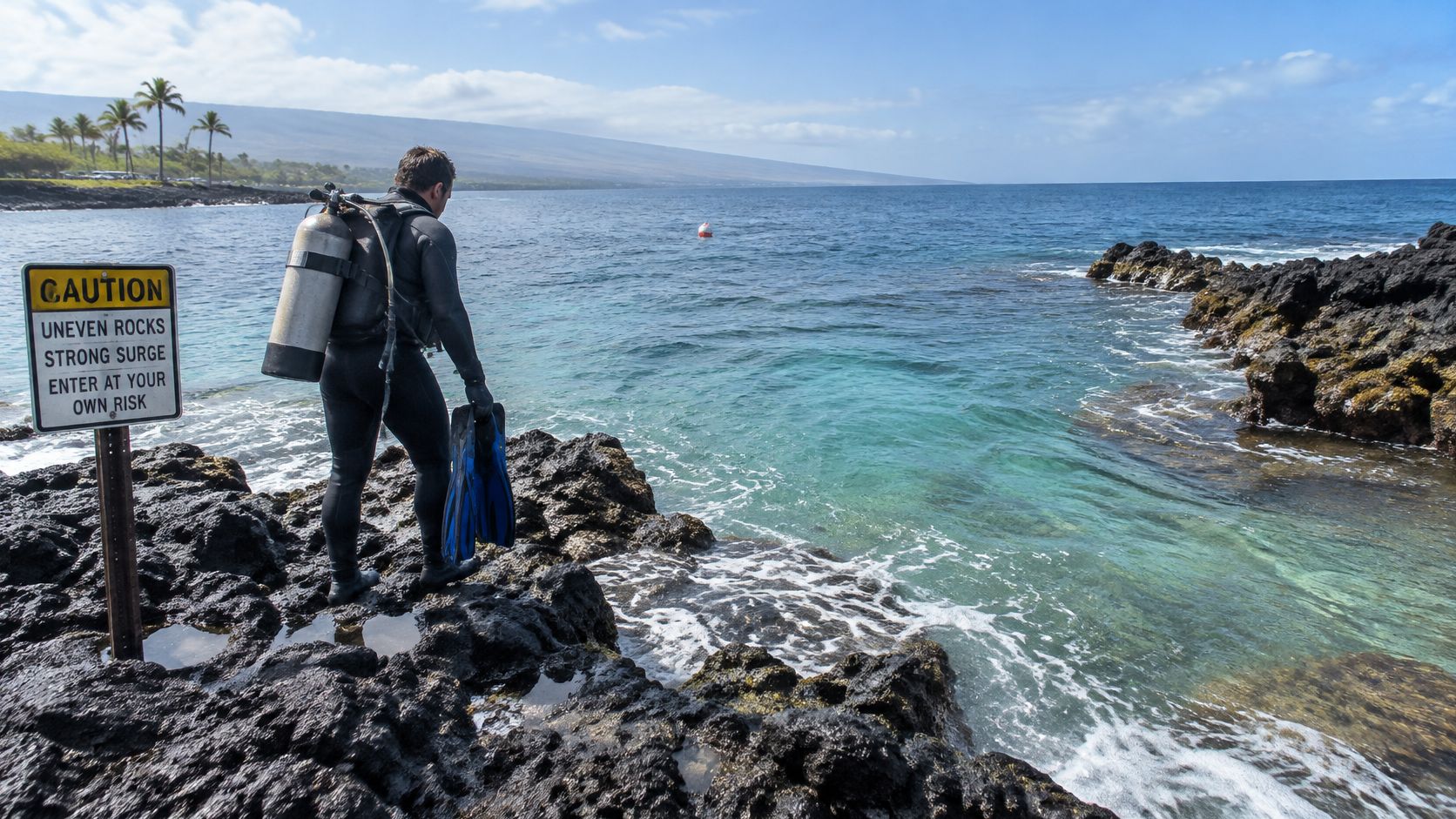
Choose a guided boat trip when an entry is steep, the surface is rough, or you're traveling without a dive buddy. A boat trip still requires safe boarding and ladder use, but it avoids committing to an unfamiliar rocky shoreline exit.
Use a shore entry only after walking the route in daylight and identifying an exit you can manage while tired. Watch incoming sets, assess where surge moves across the rocks, and identify an alternate exit. If you can't explain how you'll get out, don't get in.
Protected water comes with specific limits
The Old Kona Airport Marine Life Conservation District extends offshore toward the Kailua Lighthouse. The district's official regulations generally prohibit removing or harming marine life, including live coral, algae, limu, shells, and ʻopihi; prohibit feeding or introducing attractants near aquatic organisms; require permits for commercial dive and tour activity; and limit noncommercial mooring use to three hours per day on a first-come basis.
Don't treat an empty shell as a souvenir exemption. Also confirm current anchoring, mooring, and dive-flag requirements for your location rather than assuming rules are identical along the coast.
Go or no-go: The exit must match your mobility, equipment load, and experience, not your willingness to tolerate discomfort.
Practice responsible diver etiquette before entering protected habitat. Secure gauges, maintain clearance from the reef, and avoid using coral as a handhold while adjusting equipment.
Finish your access plan with these actions:
- Inspect conditions: Recheck the entry immediately before gearing up.
- Protect your feet: Wear suitable booties on rocky approaches.
- Arrange support: Dive with a buddy and establish a shore contact or surface-support plan.
- Leave wildlife alone: Never touch, feed, or collect.
Choose Your Itinerary and Book Your Kona Dive
- First-time visitor: Use your first day for an introductory scuba experience. Reserve the following morning for another supervised introduction or training; switch to a certified morning reef trip only if you already hold the required qualification. An introductory dive alone doesn't provide certification.
- Certified reef diver: Start with a morning reef trip, then choose another morning for different reef terrain or a suitable lava-formation site. Let the guide select the route around your demonstrated comfort.
- Manta-focused visitor: Plan a Garden Eel Cove manta evening and a morning reef dive the next day, provided your rest, surface intervals, and overall dive plan make that sequence appropriate.
- Advanced diver: Combine a premium advanced morning with a blackwater night on a separate day. Leave recovery time and don't compress demanding dives around flights or altitude travel.
Match the booking to the diver
Kona Honu Divers offers the Morning Introductory Scuba Dive, 2 Tank Local Morning Dive, Manta Ray Night Dive, Premium Advanced 2 Tank Trip, and Black Water Night Dive, along with Private Tours and Dive Packages. These formats provide the building blocks for the itineraries above, but acceptance depends on the requirements of the selected trip.
Before reserving, separate your group into certified divers, beginners, and surface participants. A shared vacation doesn't require everyone to undertake the same underwater activity. Choose a private arrangement or suitable group format when people have substantially different needs.
Use this Kona scuba-shop planning guide to organize equipment and booking questions. Give us your certification level, recent dive history, preferred dates, and any mobility or equipment-fit concerns before you arrive.
Keep room for a change
Our typical dive day begins with arrival and gear setup, followed by a briefing on conditions and entry style. The deeper or more condition-sensitive dive generally comes first, followed by a surface interval and a more relaxed second dive.
Don't demand a particular pinnacle or swim-through regardless of conditions. Tell the crew what interests you, then let current conditions and group ability determine the actual route.
Call 808-324-4668 to check availability and discuss which itinerary fits. Confirm check-in arrangements and keep a backup date free rather than filling every remaining day with activities you can't move.
Book the dive that fits your certification and reserve a backup date before arranging the rest of your island itinerary.
Frequently Asked Questions for Travelers
Do I need a medical check before diving?
Complete the diving medical questionnaire with full accuracy. If you have heart, lung, or ear conditions, or the questionnaire requires clearance, consult a physician familiar with diving medicine before participating. Tell the operator about medications and relevant health changes.
Should I buy dive insurance?
We strongly recommend dive insurance. Check for diving-accident treatment, recompression, and evacuation coverage, and read depth and activity exclusions. Don't assume ordinary travel insurance covers the dives you intend to make.
How far ahead should I book?
Reserve early if your dates are fixed or you're organizing a group. Hold an alternative date for weather changes, and review cancellation and rescheduling terms before paying.
Can I fly after diving?
Plan a conservative surface interval and follow your dive computer, training, and the operator's post-dive guidance. Allow at least 18 hours after a single dive as a conservative planning choice, and seek a longer interval after repeated diving. Discuss mountain drives as well as flights; this isn't a universal clearance to ascend.
Can I dive solo?
Use a buddy on boat trips. Independent solo shore diving isn't recommended for visitors, particularly where unfamiliar entries, navigation, and surface conditions complicate an emergency response.
Kona Honu Divers offers introductory scuba, certified reef trips, manta encounters, and advanced night diving on the Big Island. Visit Kona Honu Divers to choose the format that matches your certification, discuss your group's needs, and reserve a backup date.