
You're staring at a stack of Kailua-Kona trip pages, all promising reefs, mantas, and clear water, and you still can't tell which boat fits your card, your group, and tomorrow's swell. Star ratings won't settle it. What separates good dive shops Kailua Kona Hawaii is how they brief a site, how they run night safety, and whether they change the plan when the reef or the sea says no.
Kona Dive Trips at a Glance
Pick from the five trips below before you compare shops. The row that matches your card and your evening plans is the one to hold first.
| Trip | Best for | Time of day | Certification needed |
|---|---|---|---|
| Morning Introductory Scuba Dive | Beginners with no certification | Morning | None, introductory experience |
| 2 Tank Local Morning Dive | Certified divers wanting reefs, lava tubes and arches | Morning | Open Water Diver |
| Premium Advanced 2 Tank Trip | Experienced divers wanting more demanding sites | Morning | Confirm with shop |
| Manta Ray Night Dive | Certified divers and snorkelers | Night | Open Water Diver to dive, snorkel to join |
| Black Water Night Dive | Certified divers comfortable at night in open water | Night | Open Water Diver |
Diving in Kona runs year-round in warm water, with generally clear visibility in every season. Most boat days, including ours, start at Honokohau Harbor, so the drive and parking belong in the same plan as the dive.
Morning Introductory Scuba Dive is the right first row if nobody in your party holds a card. You stay with an instructor in a controlled setting instead of joining a certified charter that assumes you already manage your own gas.
2 Tank Local Morning Dive is the everyday certified trip. You get two reef dives on one boat, with coral gardens, ancient lava tubes, and dramatic arches, and a surface interval between tanks.
Premium Advanced 2 Tank Trip is for divers who already handle depth, current, and their own buoyancy, and who want sites that ask more than a standard local reef. Confirm the site profile with the shop before you treat it as a casual morning.
Manta Ray Night Dive is the after-dark feeding-site trip. Certified divers go under, and snorkelers can join from the surface on the same outing.
Black Water Night Dive is open water after dark, not a reef tour. Book it only if night diving and hanging in blue water already feel normal.
Shortlist two rows, one daytime and one night if you want both, then read the matching sections. The full set of options sits on our Kona diving tours page.
How to Choose a Dive Shop in Kailua-Kona
Judge a shop by the briefing you get for the site you will enter, not by a polished homepage. A useful briefing covers footing, hand placement, depth changes, surge, emergency exit options, and conservation rules, and it does that for that site rather than as a generic speech.
The Hawaii DLNR description of the Old Kona Airport Marine Life Conservation District shows why a generic speech fails. Shallow, low-profile lava fingers run offshore to about 50 feet, then the seafloor drops into very deep water. Novice and snorkel programs can use the shallow reef in calm water. Certified divers can hit a fast depth change that needs buoyancy control, gas planning, and a stated maximum depth. The southeastern entry is suitable only in calm to moderate water, and sharp coral and lava sit along the frontage. Storm swell and current can make entry and exit hazardous, so forecast, swell direction, and surge are go or no-go calls. The district also restricts taking marine life, coral, rock, or other geological features, and commercial diving needs authorization.
A boat trip with a plan is not the same thing as an independent shore entry. On a boat, the crew picks the site, watches the surface, and calls the dive. On your own, you own the entry, the exit, and the decision to stay out.
Five checks before you pay a deposit
- Site briefing: Ask what they cover for tomorrow's site. A shop that can't name the entry, the depth change, and the exit hasn't planned the dive.
- Guide ratio: Ask how many divers share a guide in the water. A smaller group is easier to keep together when surge picks up or someone loses the line of sight.
- Surface support: Ask who stays on the boat, how they run lookout, and how the diver flag is handled after dark. Night trips need a person whose job is the surface, not another diver in the water.
- Gear servicing: Ask how rental gear is serviced and whether staff size you at check-in. We size rental gear during check-in so a leaking mask doesn't show up at the ladder.
- Written emergency plan: Ask what happens if someone is separated, out of gas, or needs to get off the boat early. A verbal “we'll handle it” is weaker than a written plan the crew can repeat.
Snorkelers and ride-alongs can join our dive boat trips. Tell us when you book if your party includes snorkelers, because the headcount, the briefing, and the surface plan all change.
Read recent reviews for mentions of briefings, guide attention, and canceled dives, not for the star average alone. A five-star page that never mentions safety is a marketing score, not an operations record.
Manta Ray Night Dives and Why Garden Eel Cove Stands Out
The first manta shows up as a pale shape at the edge of the lights, wings spread, mouth open, turning through the plankton the lights have pulled in. Nobody trained that animal. It came to feed, and the divers on the sand and the snorkelers at the surface are only witnesses.
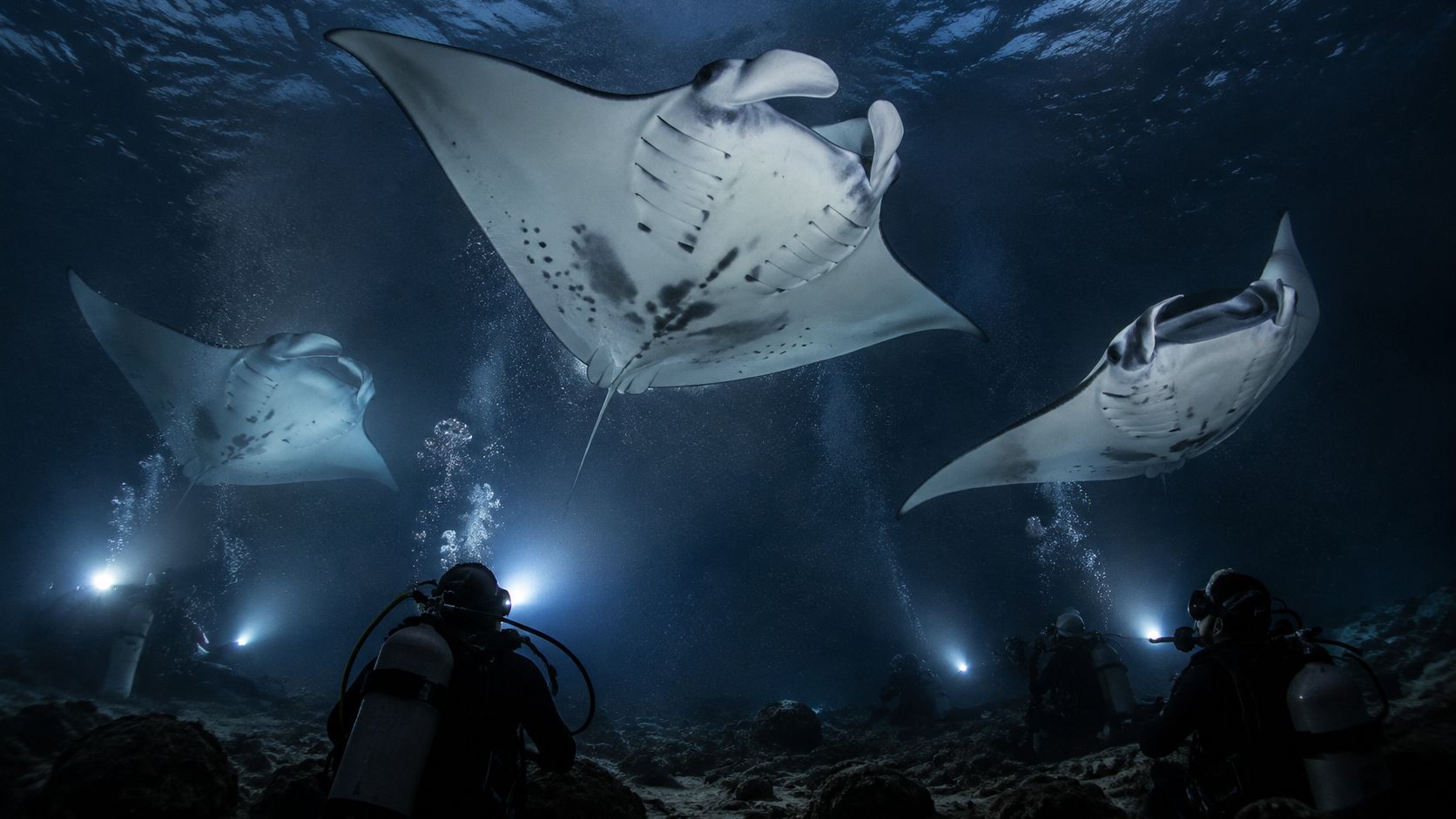
These encounters run on a small, local population, not on a random offshore pass. A University of Hawaiʻi study looked at 13 years of community observations, 2010 through 2022, at two nighttime feeding sites, Garden Eel Cove and Keauhou. The set held more than 23,000 sightings of 167 individually identified reef manta rays. Garden Eel Cove consistently supported larger aggregations. Keauhou showed a stronger presence of females, so the two sites may serve different ecological roles. Both had an overall ratio near 1:1, and females at Keauhou showed high site fidelity. Seasonal and annual changes in aggregation size tracked zooplankton density, so food availability is a major driver of who shows up. Despite more tourism, the aggregations stayed relatively stable across those years.
Why I book Garden Eel Cove for most guests
I would send most divers and snorkelers to Garden Eel Cove. Its protected location gives a better viewing area and better reefs than a more exposed night stop. That is this operator's preference, not an official state ranking. Keauhou still matters ecologically, especially for the females that return there. It serves a different purpose than a first night of viewing.
A typical night runs in a fixed order.
- Pre-dive briefing. You hear the site, the light plan, where divers sit, where snorkelers hold, and the rule that nobody touches or chases a manta.
- Lights in the water. Lights draw plankton. Mantas circle that food. The show is feeding behavior, not a performance.
- Your job in the water. Stay on your spot, control your fins, and let the animal choose the distance. Chasing breaks the pattern and puts you in the path of a wingspan you can't outswim.
Bring a warm layer for the ride back, and rest the afternoon before. No sighting is guaranteed, because the animals follow the plankton, not the reservation.
Our manta ray night dive and snorkel is the booking page if this is the trip you shortlisted. If you want the behavior and the etiquette in more detail before you commit a night, read diving with manta rays.
Practical rule: If the briefing never says “don't touch, don't chase, stay on your mark,” pick a different boat. The animals are individually recognizable, and a sloppy night follows them to the next boat.
Blackwater and Two-Tank Trips Explained
These two trips share a boat and a crew, and almost nothing else once you are in the water. One is a night spent hanging in open water. The other is a morning spent on the reef.
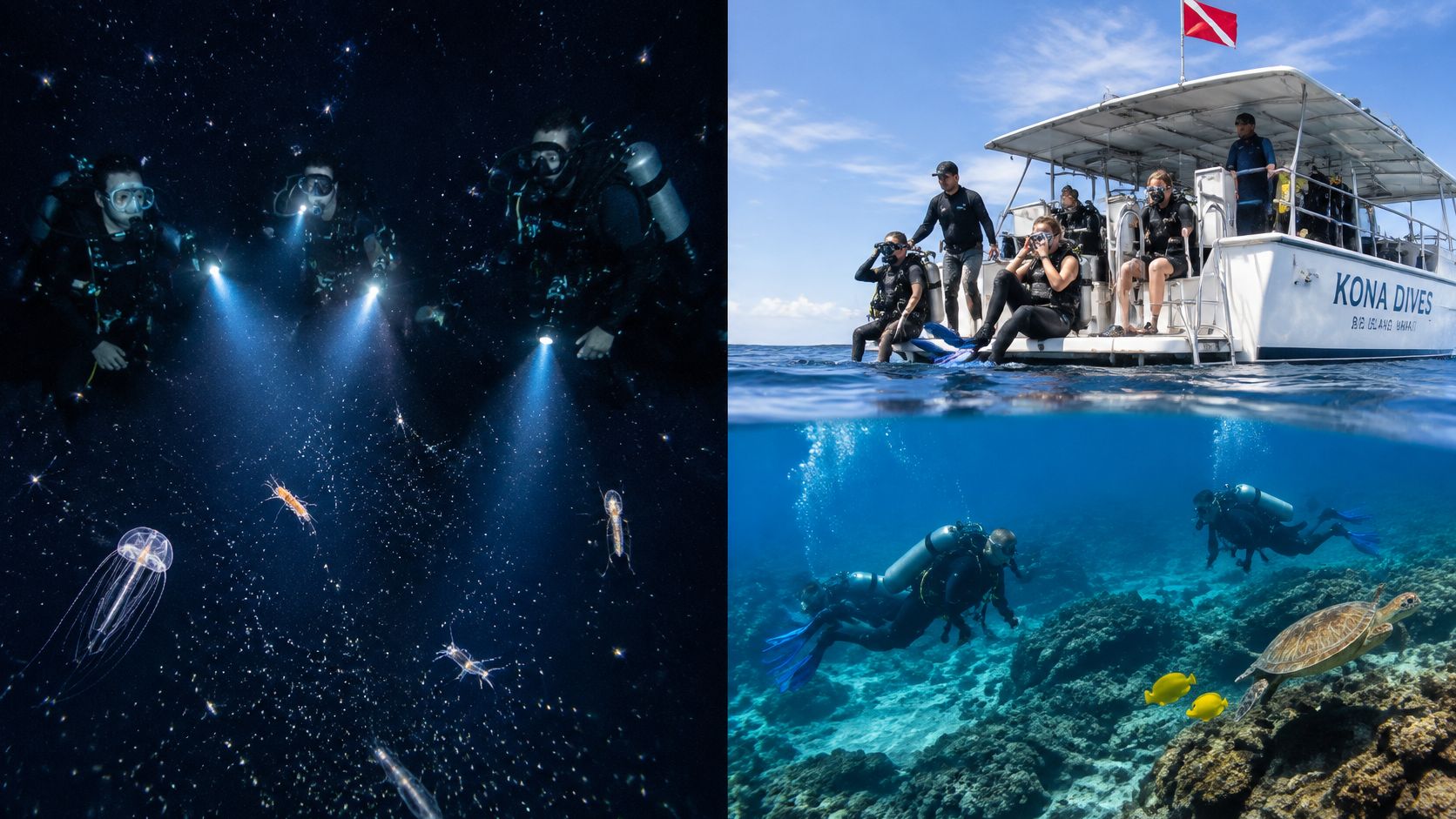
Blackwater after dark
A blackwater dive happens at night over deep water. You don't swim a reef. You hang in open water while lights draw plankton and the animals that feed on it. The skill is staying still, watching your buddy, and trusting the ascent plan. Drift and observe. Don't explore.
Hawaii's flag rules set the surface side of that plan. The DLNR diving and snorkeling rules require anyone snorkeling, scuba diving, or freediving in state navigable waters to display a diver's flag at least 12 by 12 inches. Those waters run from the high wash of the waves to three miles offshore. Divers must stay within 100 feet of the flag in ocean waters. Boats must watch for flags and run at slow, no-wake speed within 200 feet. At night the flag must be illuminated so it is identifiable from at least 100 feet away. A visible flag cuts the chance of a boat-diver conflict. It does not replace surface support, a lookout, or a controlled ascent. On our night trips I want the flag lit, a person on lookout, and the ascent briefed before anyone leaves the bench. More on how that night is run sits on our Kona black water dive page, and you can book the blackwater night dive from there.
Two tanks in the morning
A two-tank morning is two dives on one boat with a surface interval between them. The local version covers coral gardens, lava tubes, and arches. The crew handles tank changes between dives, so you spend the interval resting and drinking water, not wrestling gear. The premium advanced version uses the same shape, two dives and an interval, on sites that ask more of your buoyancy and gas plan.
Who books which:
- First night in Kona: Start with a daytime trip. Darkness plus a new boat is a poor first combination.
- Certified, stable buoyancy, already comfortable at night: Blackwater is a fair booking.
- Logged experience and a taste for harder morning sites: Book the premium advanced two-tank trip, and confirm the profile with the shop.
If you are unsure which of those three you are, you are the daytime diver. Night open water can wait for a later trip.
Certification, Rental and Nitrox Requirements
Match your case in the table, then confirm the last column when you book. Guessing at the dock wastes the morning.
| Case | Requirement | Gear | Confirm at booking |
|---|---|---|---|
| Never certified | Introductory scuba dive | Rental set sized at check-in | Dive depth and supervision |
| Open Water Diver (PADI, SSI or NAUI) | Certification card, diving to 60 feet with a buddy | Rental or own gear | Dive computer request |
| Advanced or experienced diver | Advanced certification or logged experience | Rental or own gear | Trip suitability with the shop |
| Freediver | Freediving training or experience | Freediving rental gear | Rental and class availability |
| Snorkeler on a dive boat | No certification needed | Snorkel gear | Declare snorkelers when booking |
| Nitrox user | Nitrox certification | Enriched air fills | Nitrox cost and availability |
For most of our regular dive charters, we require at least an Open Water Diver certification from a recognized agency such as PADI, SSI, or NAUI. That level allows diving to 60 feet (18 meters) with a buddy. Bring your C-card. A photo on your phone is a backup, not a substitute, if the crew asks to see the card.
People without a card, and people who only snorkel
If you have never been certified, the path is the introductory scuba dive, not a certified charter. Beginners get sized for rental gear at check-in, so arrive with time to spare. A rushed fitting is how a mask leaks for forty minutes.
Freedivers can use freediving rental gear, and we also run freediving classes. Snorkelers on a dive boat don't need a card. They do need to be named when you book, because the boat plan includes them.
Nitrox, computers, and what this page will not price
Enriched air can extend bottom time on a no-decompression dive. You need a nitrox certification to breathe it. We offer free nitrox for certified users on our trips, and you should still confirm that your card is current and that fills are available for your dates. If you want the course itself, start with enriched air certification.
Dive computers can be requested when you book. We confirm availability and any small extra cost at that time. Bring your own computer if you already trust it. Rental computers are for people who don't own one, not for people who forgot theirs in a checked bag that hasn't arrived.
This guide does not set a budget. Ask us for a written quote that separates the trip fee, the rental set, nitrox fills, and any dive computer, and ask about tank or harbor fees before you compare shops on a headline price.
Screen your own medical fitness before you pay. Recent illness, pregnancy, and any condition that affects breathing or pressure tolerance belong in that screen. Tell the shop at check-in, not after you are kitted on the boat.
One line to remember: bring your certification card, know your agency and level, and confirm rental sizing and add-ons when you book.
Safety, Site Conditions and Reef Care
Kona's calm reputation is not a guarantee of a safe entry. West-facing water changes with swell direction and season, and a lava-rock entry can turn hazardous in a single set. Treat a high-surf advisory as a reason not to enter.
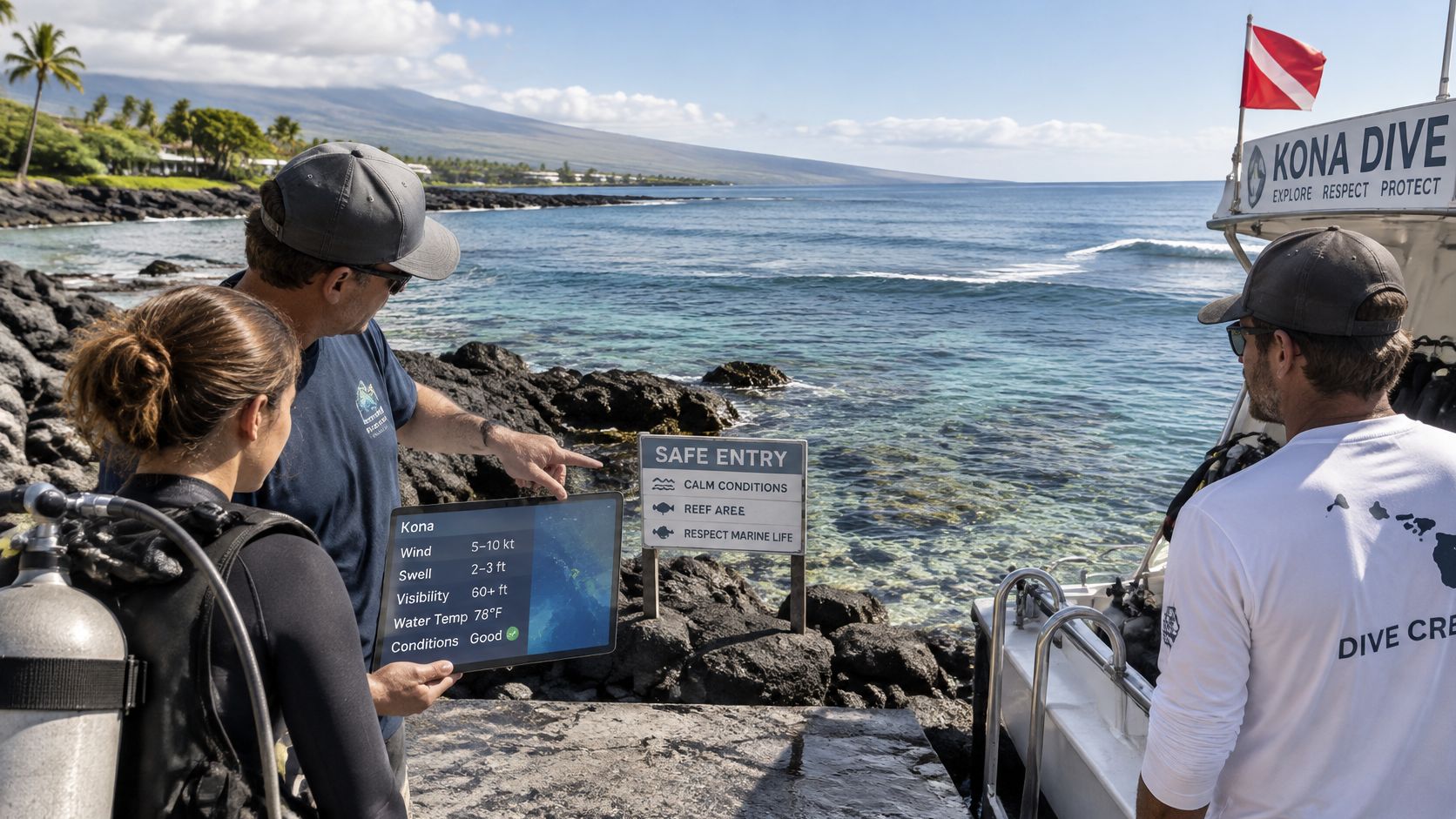
Run the same checks, in this order, before a shore entry or a boat departure.
- Marine forecast and swell direction. A south swell and a north swell don't hit the same entry.
- Posted ocean-condition warnings. A high-surf advisory is a no, not a maybe.
- Entry and current at the planned site. Look at the actual step, not at yesterday's photo.
- Visibility and crowd density for night trips. Darkness plus a packed site is a different dive than a quiet one.
- The operator's cancellation rule. Know who calls it, and what a weather cancel does to your booking, before you build the rest of the week around that morning.
Crowds at night, and reefs that are not untouched
Night manta viewing has drawn real concern about overcrowding and about having hundreds of people in the water after dark. Proposed rules would have boats tie to buoys rather than drift with engines running. A shop that treats crowd density as a safety item, not a marketing inconvenience, is the one I would book.
Reef condition belongs in the same decision. NOAA's ocean acidification reporting says warming and ocean acidification threaten Hawaiian coral reefs, and that Kona reefs may be more susceptible to acidification, with faster projected degradation than some other Big Island areas. NOAA sanctuary researchers documented a mass bleaching event across the Hawaiian Islands and saw bleaching across nearly every surveyed species in some locations.
Normal seasonal change is a shift in temperature, visibility, or which fish are around. A warning sign is widespread bleaching, pale coral across a whole site, not a single pale patch. A premium trip should not promise constant wildlife or an untouched reef. A responsible operator will change or cancel a dive for animal welfare, reef recovery, or diver safety.
Low-impact behavior is simple and essential:
- No contact: Don't touch coral, and don't stand on it to fix a mask.
- Buoyancy: Stay off the bottom. Fin kicks that hit the reef are damage, not a small mistake.
- Wildlife: Don't chase turtles, mantas, or anything else that moves away from you.
- Photos: Get the shot from where you already are. Don't kneel for a better angle.
The longer version of how we expect guests to move on a reef is on our responsible and considerate diver etiquette page.
Sample Kona Dive Itineraries by Experience
Spread the hard days. A night dive stacked on a long morning, then a flight, is how people finish a trip tired and still nitrogen-loaded.
| Trip length | Beginner | Certified diver | Experienced diver |
|---|---|---|---|
| 2 days | Introductory scuba dive, then rest | 2 Tank Local Morning Dive, then Manta Ray Night Dive | Premium Advanced 2 Tank Trip, then Black Water Night Dive |
| 3 days | Introductory scuba dive, rest day, then manta night snorkel | 2 Tank Local Morning Dive twice, then Manta Ray Night Dive | Premium Advanced 2 Tank Trip, Black Water Night Dive, then rest day |
| 5 days | Introductory scuba dive, two rest-spaced snorkel days, then manta night snorkel | Two 2 Tank Local Morning Dives, a rest day, then Manta Ray Night Dive | Advanced 2 Tank Trip, Black Water Night Dive, a rest day, then 2 Tank Local Morning Dive |
Beginners stay on the introductory dive and a surface manta night. Certified divers can repeat the local two-tank morning and add one manta night. Experienced divers can add the premium advanced morning or a blackwater night, then take a day off the tanks.
Our dive days start at Honokohau Harbor. Plan the drive and the parking before the first morning, especially if you are coming from a resort farther up the coast. A late arrival doesn't move the boat.
Flying and altitude after the last dive
Common diving medical guidance generally suggests waiting at least 12 hours after one no-decompression dive, and 18 to 24 hours after several dives in a day or any dive that required decompression, before you fly. Put the heaviest diving earlier in the stay, then a rest day, then the airport. The same caution applies to a drive that climbs well above the coast. If the swell changes, drop a day rather than forcing the original grid. Season and swell patterns are laid out in the best months to scuba dive in Hawaii.
Build the itinerary around the last dive and the flight, not around how many boats you can fit. One skipped morning is cheaper than a pressure problem on departure day.
Book Your Kona Dive and Confirm the Details
Open live dates with the button below, then book the one trip you circled in the first table. Manta nights fill, so hold that date before you shop the rest of the week. If you still have a question before you pay, call 808-324-4668.
Before you pay, reconfirm only what you have not already settled.
- Harbor and parking. The start point is Honokohau Harbor. Know where you will leave the car.
- Headcount. Name every snorkeler in the party, not only the certified divers.
- Nitrox. Get price and availability in writing if anyone in the group needs enriched air.
- Dive computer. Say whether you want one, so availability is checked before the morning of the trip.
Kona Honu Divers is the highest-rated and most-reviewed dive shop in all of Hawaii. Read recent reviews for briefings, guide attention, and how weather cancels were handled. A star average without those details doesn't tell you how the boat runs.
Choose one trip, book it, then confirm the harbor time, the headcount, and any nitrox or computer request by phone.
Kona Honu Divers runs guided reef, manta, and blackwater trips out of Kailua-Kona, with site briefings, night safety, and reef-care rules built into the day. If you are choosing among dive shops in Kailua-Kona, start with the trip that matches your card, then let the conditions decide the rest. Visit Kona Honu Divers to see the tours and lock a date.