
Table of Contents
- A three-step pick
- What the rows mean in the water
- Why the cast list changes
- What the dive demands
- A numbered seasickness routine
- Low-impact conduct
- Book in this order
- What goes in the bag
- Packages and the wider shop
- Three questions for any operator
- The decision rule
You're on the Kona harbor dock at dusk, fins in one hand and a confirmation in the other. A diver beside you is checking a regulator. Someone else is asking if a snorkel mask is enough. You want a night with reef mantas, but you also need the boat to match your card, your group, and the one free morning you have.
That mismatch is what is usually meant when searching for Big Island divers in Kona. The coast offers night feeding dives, open-ocean blackwater dives, morning reef dives, and longer trips to remote sites. Wildlife is never guaranteed. Plankton, current, and your certification determine the outing more than any photo. I would match the trip to your hours, your card, and who is traveling with you before I matched it to an animal.
Kona Dive Experiences at a Glance
| Experience | Time of day | Certification needed | Best fit | What you see |
|---|---|---|---|---|
| Manta ray night dive | Night | Open Water to dive; snorkel at the surface without certification | Divers wanting a signature night encounter | Reef manta rays feeding in the lights |
| Blackwater night dive | Night, open ocean | Open Water, with night dive experience | Experienced night divers who enjoy plankton | Salps, siphonophores, ctenophores and larval fish |
| 2-tank morning reef dive | Morning | Any certified diver | Visitors with one free morning | Coral gardens, ancient lava tubes and swim-throughs |
| Daytime reef charter | Daytime | Open Water for most regular charters | Divers wanting a relaxed day on the water | Reef fish and coral in clear Kona water |
| Premium advanced 2-tank long-range trip | Daytime, remote sites | Advanced certification; crew confirms | Experienced divers wanting remote sites | Less-visited reefs reached by a longer boat ride |
We run night and morning reef dives along the Kona Coast, plus daytime charters. The 2-tank morning dive is open to any certified diver and works through coral gardens, ancient lava tubes, and swim-throughs. The full schedule sits on the diving tours page.
A three-step pick
Time window first. A single free morning points to the two-tank reef dive. A night you can stay out points to mantas or blackwater, not both on the same evening if you are new to either.
Certification second. Most regular charters need at least Open Water. On a manta night, that card is what lets you descend. Without it, you stay at the surface on a snorkel. Advanced long-range trips are for divers the crew has already cleared for remote sites.
What you want to see third. Reef color, a feeding column, or tiny drifting animals are different trips. Chasing all three in one booking is how groups end up on the wrong boat.
Night dives suit divers who are already comfortable underwater after dark. Morning dives suit most certified divers with one open morning and no appetite for a black ocean. The table shows typical formats. The crew confirms the final certification requirement for each trip before you book, using your card and your recent dives, not a guess from the website.
Manta Night Dives and Why Garden Eel Cove Leads
For the manta ray dive, Garden Eel Cove is the superior choice. It has a protected location, a better viewing area, and better reefs than the alternative night site. Trip details are on the manta ray dive tours page.

| Factor | Garden Eel Cove | Keauhou |
|---|---|---|
| Nightly aggregation size | Consistently larger groups in the 2010–2022 study | Smaller groups |
| Protected viewing area | Protected location with a better viewing area | Designated zone, more exposed to boat traffic |
| Reef quality | Better reefs | Secondary to the light column |
| Historical sighting rate | Mantas on 80% of dives (legislative testimony) | No yearly percentage in that testimony |
| Female visitation | Mixed, near an even overall sex ratio | Female-dominated, with high female site fidelity |
A University of Hawaiʻi study of community observations from 2010 through 2022 logged more than 23,000 sightings of 167 identified reef mantas at Garden Eel Cove and Keauhou. Garden Eel Cove consistently held the larger groups. Keauhou drew especially faithful females. Across both sites the sex ratio was about 1:1, and group size tracked zooplankton density.
What the rows mean in the water
Aggregation size is why I send signature-night guests to Garden Eel Cove. More animals in the light column means more passes, not a promised head count.
The protected viewing area keeps you in a set zone with reef behind the beams. Keauhou is also a managed night site, but it is not the spot I pick when the goal is a cleaner stage for the same behavior.
Reef quality matters because you are not floating in a blank pool. At Garden Eel Cove the bottom is part of the picture. You see mantas glide through the light at close range with living reef behind them.
The historical rate comes from Hawaiʻi State Legislature testimony: mantas were observed on 80% of dives at Garden Eel Cove each year. That is a historical benchmark, not a current population census, and not a promise for your night.
Female visitation is the one row that favors Keauhou. Researchers found high female site fidelity there. If your question is ecology rather than the best viewing setup, that difference is real. It does not beat the protected cove for a guest dive.
Lights pull zooplankton into a column. Mantas rise to filter-feed. A quiet plankton night is a quiet manta night, even at the better site. The table rates the dive, not the animals on a given evening.
Blackwater Night Dives and What You Actually See
A blackwater night dive is like watching a city from a hilltop. The "lights" are small, they drift, and they vanish. There is no reef under you, only a dark water column where animals rise from depth to feed.

Say you drop on the same mooring two nights in a row. Night one gives you chains of salps and a siphonophore that looks like a glass rope. Night two is mostly ctenophores, those comb jellies that flash when your light hits them, plus a larval fish the size of a fingernail. Nothing is "wrong" with the second night. The city changed tenants.
Why the cast list changes
NOAA-supported nighttime scuba near Kona, covered in a Hawaii Magazine account of the night water, found salps, siphonophores, and ctenophores among the most abundant groups. Over 19 months, a model tied to water temperature, bathymetry, and the El Niño–Southern Oscillation index explained 43% of the variation in what observers recorded. Separate work collected 76 larval fish and checked them with DNA barcoding. In-water viewing shows delicate structures that nets tear apart.
That is the trade-off. You see animals intact, and you also accept that temperature and ocean conditions rewrite the show between nights.
What the dive demands
- Slow finning: A hard kick swirls the animals you came to watch. Short, soft kicks keep the water still.
- Precise buoyancy: There is nothing to hold. If you cannot hover, you will yo-yo through the plankton.
- Redundant lights: One primary and one backup. A dead light in open ocean ends the dive.
- Clear of the descent line: The line is a reference, not a perch. Stay off it so you do not tangle or block other divers.
Blackwater suits experienced night divers who are fine with almost no visual references, and divers who would rather watch transparent drifters than bright reef fish. If you want color and a bottom you can read, pick a reef charter instead. More on the profile is in this blackwater dive in Kona guide, and you can compare dates on the Blackwater Dive tour page.
Safety, Gear and Seasickness Prep
Bring a valid certification card, a logbook with recent dives, a fit-to-dive check, and reef-safe sunscreen already on your skin before you board. The crew handles gear setup, so you arrive ready and only confirm that the BCD, mask, and weights fit.
A numbered seasickness routine
- Pick a pill before the trip. Dramamine pills or Bonine pills, taken as labeled, typically 30 to 60 minutes before departure, beat a tablet swallowed at the dock.
- Add a drug-free backup if pills do not suit you. A Ship-EEZ Seasickness Patch or Sea Band wristbands can sit alongside, or instead of, medication. Sea Band is the cheaper generic, and it picks up better ratings than pricier lookalikes.
- Carry ginger chews for mild queasiness once you are underway. They will not fix a heavy swell by themselves.
A longer prep list is in this guide to avoiding seasickness. If you know you get sick, say so at booking. A seat amidships and eyes on the horizon help more than heroics at the rail.
Low-impact conduct
Hawaiʻi's Q4 2025 Visitor Satisfaction and Activity Survey put snorkeling across markets at roughly 12.9% to 78.6%, while scuba stayed between 0.0% and 3.0%. Most visitors meet this coast from the surface. That does not make a dive a private show, and no ethical operator can promise an animal.
- Control your buoyancy. An uncontrolled fin strike hits coral or another diver, and both ruin the site you paid to see.
- Never touch or chase wildlife. A manta that turns away is choosing a route. Following it breaks the feeding pass for everyone.
- Point lights away from mantas. Beams are for the plankton column and your buddy checks, not for blasting an animal's eyes.
- Use reef-safe sunscreen. Chemical film on a crowded night is a guest problem, not a manta problem you can shrug off.
- Follow the crew's boat position. Where you sit, enter, and exit is set so props, lines, and other boats stay predictable.
Practical rule: If you cannot name your return signal and your viewing spot before you leave the bench, you are not ready to enter.
Booking, Pick-Up and What to Bring
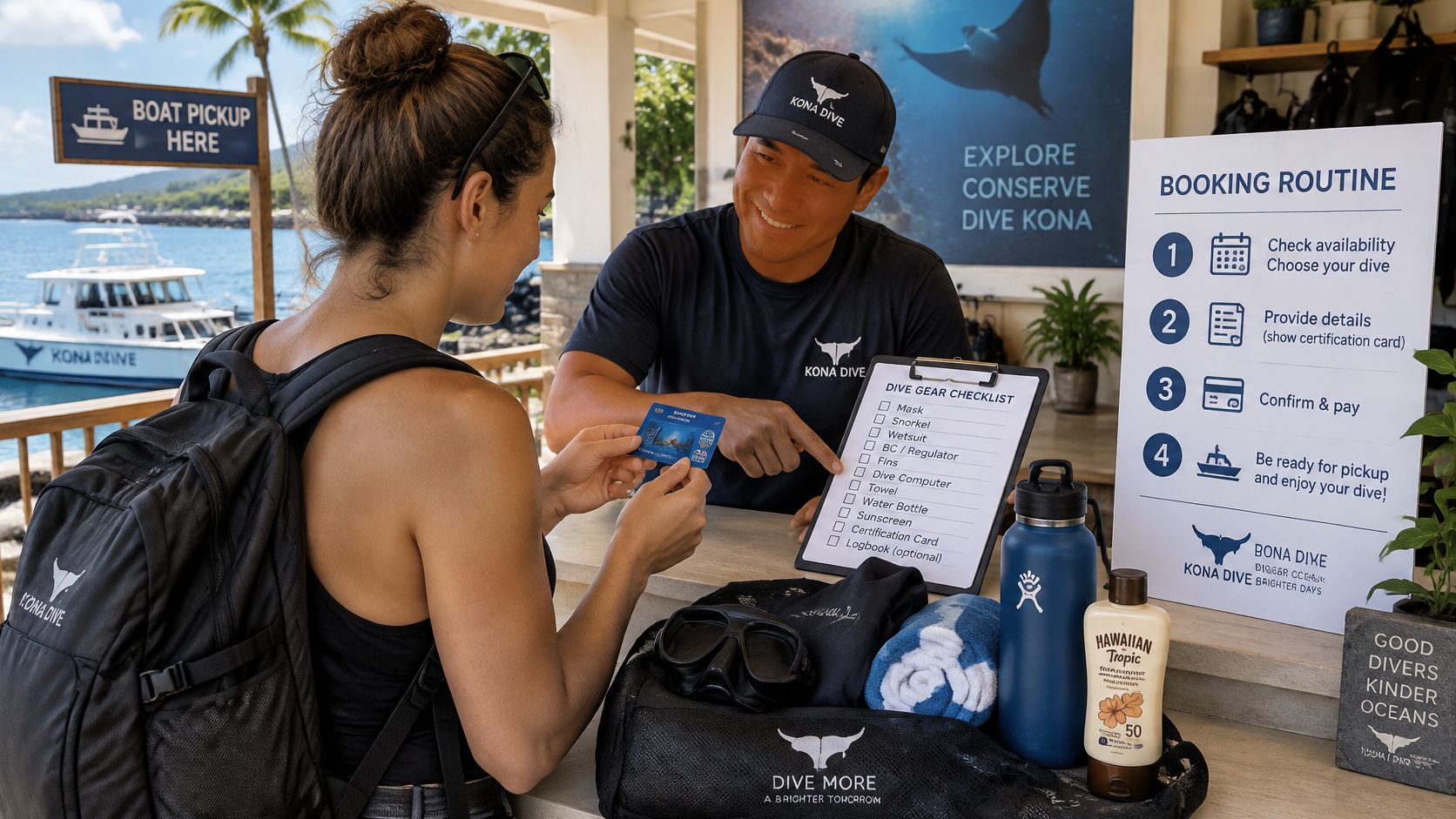
Book in this order
- Confirm your certification. For most of our regular charters you need at least an Open Water Diver card from a recognized agency such as PADI, SSI, or NAUI. On manta nights the card decides the view. A University of Hawaiʻi at Hilo article notes that non-certified guests stay at the surface on a snorkel, while scuba divers must hold the certification to descend. The same piece puts individual mantas at as much as 3,600 pounds, which is a reason to hold your assigned spot rather than swim into a feeding loop.
- Choose the trip by time window and conditions. A morning reef dive and a night specialty are not interchangeable backups. Pick the one that fits the hours you have, then ask what the wind does to that specific site.
- Check availability online or call 808-324-4668. A phone call is faster when your card is old, your last dive was years ago, or the group is mixed.
- Confirm hotel pick-up time and the meeting point in writing when you book. "Harbor" is not a pin. You want the lot, the boat name, and the minute you should be standing there.
- Arrive with the packing list done. Hunting for a card in the parking lot burns the briefing.
What goes in the bag
Pack your certification card, logbook, swimwear, towel, reef-safe sunscreen, water, a hat, any motion-sickness medication, and a dry bag for wet gear. Night trips return after dark, so add a warm layer and a small light for the walk back to the car. More packing judgment calls are in these dive travel tips.
If ocean conditions cancel the plan, ask two things before you pay: how the operator reschedules, and what happens to your spot if the boat does not go. A written answer beats a shrug at the dock.
What Sets Kona Honu Divers Apart
Treat "best" as something you can check. Kona Honu Divers was voted best dive operator in Kona. That vote is a starting point, not a reason to skip questions.
Small groups from the moment you step aboard is a practice, not a slogan. We deliberately keep dive groups small and give personal attention as soon as you are on the boat. Ask how many divers share each guide on the day you want. If the answer is a crowd, the vote does not help you.
More than 200 years of combined staff experience is the other check. Experience shows up when a site call changes because of swell, not in a speech at the shop. The same crew assembles and maintains the gear. Custom dive boats and proactively serviced rental gear matter because a failed inflator or a sloppy weight belt is what spoils a morning.
Packages and the wider shop
Early-diver discounts and free nitrox sit inside package deals for divers who book ahead and already hold the nitrox card. You are not paying a surprise upcharge for enriched air on those deals, and you are not locked into a single headline animal. Multi-day packages work the same way: stack reef days rather than gambling the whole trip on one night. The shop also runs snorkel excursions, gear rentals, repairs, and dive travel support, so a mixed group is not sent to three different counters. How that lines up with reef care is spelled out on our eco-friendly practices page.
Three questions for any operator
- How many divers share each guide on this exact departure?
- Who checks certification before the site is chosen?
- Is nitrox included or extra if you are already certified for it?
If those answers are vague, keep looking. If they are specific, you can book.
Common Questions and Recommended Itineraries
Do I need certification for the manta night? The card decides whether you descend. Without it, you watch from the surface on a snorkel.
Is a manta sighting guaranteed? No. Nightly plankton, current, and site behavior run the show. No ethical operator can promise a count.
Which site is better for mantas? Garden Eel Cove, for the protected viewing area and the reef behind the lights.
What if I get seasick? Use the pill, patch or band, and ginger sequence in the safety section, started before you leave the hotel.
What if ocean conditions cancel my trip? Ask how rescheduling works before you pay, and get that answer in the booking notes.
| Traveler | Suggested dives | Why it works |
|---|---|---|
| One free morning with Open Water | 2-tank morning reef dive | Coral gardens, lava tubes and swim-throughs in one morning |
| Two or more days, certified diver | Morning reef dive on day one, manta ray night dive on a later night | Recovery time between dives, and a wildlife night once the reef is familiar |
| Experienced night diver | Blackwater night dive plus a daytime reef charter | Contrasts plankton-driven open water with reef colour |
| Advanced diver wanting remote sites | Premium advanced long-range trip plus a morning reef dive | Remote sites with a familiar reef on the same trip |
Do the easy, familiar dive first. A specialty night is a poor place to discover that your buoyancy is rusty.
Which Dive Fits Your Level, Group and Time
Hawaiʻi's official Visitor Satisfaction and Activity Survey for Q3 2025 reported scuba participation of only 2.6% to 4.6% across surveyed visitor markets, while snorkeling ranged from 19.1% to 50.1%. Many people in the water here are not on scuba. Booking a dive because the photo looked good is how anxious guests and strong divers end up on the same unhappy boat.
Novice Open Water divers who want reef and a calm first day should take the morning two-tank. Coral gardens, lava tubes, and swim-throughs give you a bottom you can read and a guide close by. Skip blackwater and remote long-range until your logbook shows recent, comfortable dives. We always check each diver's certification and logbook before choosing sites that match the skill set. If your last dive was a long time ago, say so. A refresher beats a ruined morning. Whether you need recent experience for Big Island dives is covered in this note on experience requirements.
Advanced divers who want deeper, less-visited reef should look at the premium advanced 2-tank trip. It is the long-range option that reaches remote sites. The crew still confirms you belong on it. A higher card with no recent ocean time is not a free pass.
Families and mixed groups should follow one rule. Choose the dive the least-experienced certified diver can finish comfortably, and let non-divers take a snorkel-based option on the same coast. Forcing a nervous snorkeler onto a night scuba plan, or parking a keen diver on a surface-only boat, splits the fun either way. Kona Honu Divers, in Kona on the Big Island, runs dive and snorkel tours and offers Big Island scuba diving discount packages, so the two halves of a group do not have to use different companies.
Visitors with one free morning, or with anxiety about the water, should not start in the dark. A morning reef charter is shorter on unknowns: daylight, a visible bottom, and a return before the day is gone. Anxiety plus a black ocean is a bad first combination. Snorkeling, or a shorter introductory session, is the honest pick if you are not certified and not sure you want to be.
The decision rule
One free morning and an Open Water card: take the 2-tank morning dive. A night wildlife encounter: take the manta ray dive at Garden Eel Cove. Open-ocean night diving for plankton: take blackwater, and only if night diving already feels normal. An advanced diver who wants remote sites: take the premium advanced long-range trip.
Next, check the date, confirm your certification, and book. If the dates or the card are unclear, call before you pay. A five-minute conversation saves a boat ride you are not ready for.
Kona Honu Divers runs reef, manta, and blackwater trips out of Kona so you can match the boat to your card, your group, and the hours you have. Wildlife stays wild, and the right trip is the one you can enjoy without chasing a promised animal. Visit Kona Honu Divers to compare dates and book the dive that fits.